
Knowledge
One Flag Short of Bank Approval: Near-Prime Borrower (Singapore)
Near-prime borrower Singapore: how one flag, such as variable income or a thin credit file, turns a bank yes into a no, and where licensed lenders price you.
Borrowers just below bank approval hold an otherwise sound profile with one flag, such as a thin credit file, variable income or a stretched debt load, that leads a bank to decline them or lend less than they need. Licensed moneylenders assess the same profile under separate legal caps, with interest capped at 4% p.m.
Who Falls Just Short of Bank Approval
You sit just below bank approval when your profile clears most bank checks but trips one, such as a thin credit file, variable income or a stretched debt load; licensed moneylenders assess you under separate legal caps.
Table: which profiles count as borrowers just below bank approval, and how banks and licensed lenders see each one.
| Profile | Bank view | Licensed lender view | In this group? | Why |
|---|---|---|---|---|
| Steady salary, clean record, income well above bank minimums | Approval likely, subject to the bank's own assessment | Lends within the aggregate limit | No | Banks price this profile lower |
| Income of S$2,500 to S$4,000 a month (FundBright's lower segment) | At or above the income minimums banks set (S$20,000 to S$30,000 a year), in the band where MAS limits unsecured credit to up to 4 months' income | Lends up to 6x monthly income | Often | Bank limits are smallest here |
| Income of S$4,000 to S$7,000 a month with one complication (FundBright's core segment) | Eligible on income; the complication weighs on the decision | Lends up to 6x monthly income | Often | One flag, otherwise sound |
| Variable or commission income | Asks for extra income documents | Lends on the income evidence | Often | Harder for a bank to verify, in FundBright's view |
| A single late payment | Part of the bank's creditworthiness review | Sees repayments on licensed loans in your MLCB record | Sometimes | Depends on the rest of the profile |
| Several missed payments, or unsecured licensed debt already at the aggregate limit | Decline likely | No new unsecured loan above the limit | No | Beyond this group; debt advice first |
Is this about my income or my credit record?
It is about both your income and your credit record, and neither one alone decides it, because FundBright treats this group as a credit profile, not an income bracket. Your income decides which bank products are open to you under the MAS rules and each bank's own minimum, and your credit record decides how a lender reads the rest of your profile. FundBright's two income bands are its own segment data and its best current working estimates, not legal thresholds.
Why One Flag Changes the Bank's Answer
A bank works out how much you are eligible to borrow from its own assessment of your creditworthiness, shaped by your income, your other loan commitments and your credit score, so one weak input changes the answer or the amount. A bank application works like a lending checklist, and a borrower in this group passes most items and misses one, such as a thin file, variable income or a stretched debt load, which is enough to change the bank's answer or the amount. A bank decline tells you how that bank weighed your profile against its own criteria, not how a licensed moneylender reads it.
DBS's guide to unsecured loans names your monthly salary and other loan commitments as the influences on that assessment, with your credit score playing a part in the loan amount.
The flags behind a bank decline
The flags behind a bank decline are your income against the bank's minimum, the income cap on bank credit, your commitments and your credit score. MAS's rules on granting non-card unsecured credit facilities set an annual income floor of S$20,000 and limit unsecured credit to up to 2 months' income below S$30,000 a year and up to 4 months' income from S$30,000 to below S$120,000. Each bank then sets its own minimum: OCBC asks S$20,000 a year from Singapore Citizens and PRs, and DBS and UOB ask S$30,000 (checked on 18 November 2026).
Take a monthly income of S$2,500, which is S$30,000 a year, and you clear each of those minimums, yet the MAS limit of up to 4 months' income caps the unsecured credit a bank grants you at S$10,000.
The outer line is the MAS borrowing limit on unsecured credit, set at 12x monthly income since 1 June 2019, and you get no additional credit facilities and your existing ones are suspended once your interest-bearing unsecured debt across all financial institutions exceeds 12x your monthly income for 3 consecutive months. Past that line, you are no longer just short of approval. FundBright also sees buy-now-pay-later use as a complication in this group; MAS notes that BNPL providers check an industry BNPL credit bureau that tracks users' outstanding balances.
How a CBS grade boundary works
Credit Bureau Singapore turns your bank and card borrowing record into a score and a grade band, and banks read that report when they assess you. Near a band edge, a small change in score moves you into the next grade, and a bank reads that grade together with your income and other factors. Your grade sits next to your score on your CBS report, so read how your CBS score works before you apply to a bank.
What licensed lenders look at instead
Licensed moneylenders assess you under the separate rulebook of the Moneylenders Act 2008. A licensed lender obtains your Moneylenders Credit Bureau (MLCB) report before granting a loan (s 66 of the Act), and that record holds your licensed-moneylender loans, with no bank data. The aggregate limit caps the unsecured amount you borrow from all licensed moneylenders combined at 6x your monthly income once your annual income reaches S$20,000, which for FundBright's two segments, from S$2,500 to S$7,000 a month, comes to S$15,000 to S$42,000. Interest stops at 4% p.m., and the Registry of Moneylenders states the identity rule in these words: "Licensed moneylenders are required to meet the borrower in person at the approved place of business ... to conduct physical face-to-face verification of his identity before granting any loan."
In FundBright's view, licensed moneylenders "assess risk differently from banks", are "not bound by MAS income thresholds" and "don't rely on CBS scores as a primary underwriting tool".
Where This Profile Sits Among Borrower Groups
Borrowers fall into three broad groups: those banks approve, those just below bank approval, and those already at their borrowing limits.
Table: borrowers just below bank approval beside the two groups on either side of them.
| Group | Typical profile | Bank answer | Licensed lender answer | Typical rate range | Example |
|---|---|---|---|---|---|
| Clear bank approval | Income above bank minimums, clean record | Approved | Rarely needed | Bank EIR as advertised by each bank | Salaried, no other loans |
| Just below bank approval | One flag in an otherwise sound profile | Declined, or approved for less than needed | Offers made within the legal caps | From an illustrative sub-ceiling offer at 2.5% p.m. with a 5% admin fee (EIR about 40% p.a., APR as shown on FundBright 35% p.a.) up to the 4% p.m. ceiling with a 10% admin fee (EIR about 70% p.a., APR as shown on FundBright 58% p.a.) | Commission earner after a bank decline |
| Unable to borrow more | Several missed payments, unsecured debt across financial institutions above 12x monthly income for 3 consecutive months, licensed debts at the aggregate limit, or self-excluded | Declined; no new credit above the 12x line | No new unsecured loan above the aggregate limit; self-excluded borrowers get no new unsecured licensed loan except a debt consolidation loan under the Registry's scheme | Not applicable | Debt advice or consolidation first |
The cap on total charges that binds licensed lenders comes from the Registry of Moneylenders guide for borrowers.
Does falling short of a bank approval mean I have bad credit?
No, falling short of a bank approval means your profile missed one bank's criteria, not that your credit is bad. Licensed moneylenders assess this group under their own rules, within the aggregate limit and the legal interest cap, and the interest and fees on a licensed loan, taken together, stop at the amount you borrowed.
What Shapes the Rate You Are Offered
Three things shape the rate a lender offers you: what the lender knows about you, how the lender prices, and how the platform you compare through earns its commission.
Your credit profile and income records
Complete income records and a clear credit history give a lender a reason to price you below the ceiling. In FundBright's view, lenders "still extend an offer, priced conservatively at the regulated ceiling, rather than decline outright" when lender information on a borrower is limited. A licensed lender also reads your MLCB record before granting a loan, a duty set by s 66 of the Moneylenders Act 2008 on Singapore Statutes Online, so declaring every licensed loan you hold keeps your offer in line with what the lender checks.
The lender's pricing
A licensed lender prices you at or below the legal ceiling, and the Registry of Moneylenders guide for borrowers sets that ceiling at 4% p.m. interest with an admin fee (the Act's upfront fee) of up to 10%, taken from your payout.
Take a S$5,000 loan over 12 months at the 4% p.m. ceiling with a 10% admin fee. You receive S$4,500 and repay S$532.76 a month, an EIR of about 70% p.a. and an APR as shown on FundBright of 58% p.a. Now take an illustrative sub-ceiling offer at 2.5% p.m. with a 5% admin fee on the same S$5,000. You receive S$4,750 and repay S$487.44 a month, an EIR of about 40% p.a. and an APR as shown on FundBright of 35% p.a., and you repay about S$544 less over the year. The 2.5% p.m. figure illustrates a sub-ceiling offer and is not a FundBright partner rate.
FundBright's live calculator estimates monthly repayments at licensed-moneylender rates, from 1% to 4% a month. Across all FundBright's lending partners, including CIMB, a licensed bank, APRs run from 1.94% p.a. to 58% p.a. for loans of 12 months or more, and your own APR is confirmed at the end of the application. With no admin fee, the APR as shown on FundBright equals the EIR.
How the platform earns its commission
The way a comparison platform earns its commission changes how far a lender has reason to price below the ceiling. A platform's flat commission gives a lender no commission reason to offer you less than the ceiling rate, because the commission stays the same whatever the rate. In FundBright's view, commission design is one of the biggest factors behind ceiling offers, not the only one.
Why am I seeing the ceiling rate?
Three causes put an offer at the ceiling rate: the lender has limited information on your profile, the lender prices every applicant at the cap, or the platform you compare through earns the same commission at any rate. Each cause has a different fix, so see why your personal loan rate sits at the 4% monthly maximum before you accept an offer at the ceiling rate.
Situations Where This Applies to You
Falling just short of bank approval tends to show up in three situations: after a bank decline, after a change in how you earn, or when card balances have rolled over.
After a bank decline
Compare offers before you approach licensed lenders one by one, because a bank decline reflects one bank's own criteria and income rules differ by bank. UOB's personal loan page asks a minimum annual income of S$30,000, for example, while OCBC asks S$20,000 from Singapore Citizens and PRs. Each lender you approach directly runs its own checks before granting a loan. A platform that earns less when a lender offers you a lower rate gives that lender a reason to price below the ceiling, so see how inverse commission changes loan offers before you choose a way to compare.
With commission or freelance income
Banks ask commission and freelance earners for extra income documents. OCBC's ExtraCash Loan page lists different required documents for salaried, self-employed or variable-income and new-to-workforce applicants. In FundBright's view, inconsistent income leaves these borrowers likely unable to borrow from a bank, or able to borrow less than they need. Licensed lenders work from the income evidence you bring.
When card balances have rolled over
Card balances that roll over from month to month are interest-bearing unsecured debt, the kind MAS counts towards its 12x borrowing limit, and a bank weighs them with your other loan commitments. MAS figures on credit and charge cards, published on data.gov.sg, show more than S$9.6 billion in rolled-over card balances in the second quarter of 2026, when card issuers reported about 6.2 million principal cardholders. Check any new repayment against your take-home pay before you add a loan. FundBright treats a monthly repayment that takes 30 to 40% of take-home pay as a warning sign. Debt consolidation is the route to weigh when several card balances have rolled over.
What Inverse Commission Changes
With inverse commission, a lender that offers you a lower rate pays FundBright a lower commission, so pricing below the 4% p.m. ceiling costs that lender less to win your loan. You select an offer, FundBright hands you over to that lender, the lender verifies you in person and confirms the final terms, and FundBright reconciles the final disbursed terms with the lender and with you, so each loan is verified through end-to-end reconciliation. FundBright is a comparison platform, not a lender, and the single MLCB check happens once, in person, at the lender you choose.
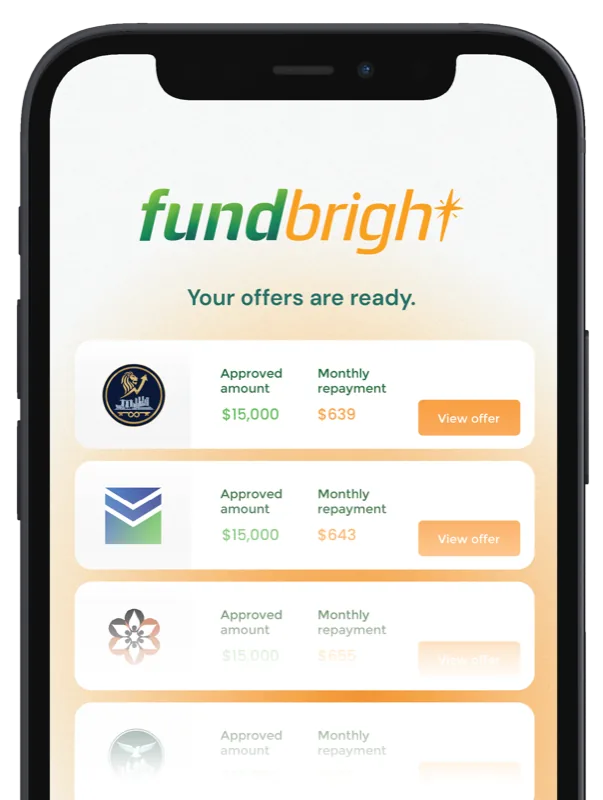
If your quotes keep landing at the 4% p.m. ceiling, inverse commission gives lenders a reason to offer you less, so the next step is to compare licensed offers through Personal Loan Comparison (Singapore), which lines up licensed offers on one soft enquiry.
Best offer wins. No priority, no favourites. You stay in control.
Ready to find your best rate?
Compare Offers NowThese might also help
Ready when you are.Ready when you are.
checking will not affect your credit score