
Guides
Debt Consolidation Loans
Debt consolidation loan comparison for borrowers below the 12x DCP entry floor. FundBright compares licensed moneylender rates on inverse commission.
Introduction
FundBright is a Singapore debt consolidation loan comparison platform that serves borrowers stuck between bank approval and licensed-lender ceiling rates, stranded below the bank DCP entry floor. Licensed moneylenders on the platform pay a lower commission fee when they offer a lower rate on the consolidated facility. The lender that offers the lowest rate pays FundBright the least. That structural mechanism restores rate competition for borrowers that other platforms route to ceiling-rate lenders.
The Moneylenders Act and its permitted-fees schedule caps the administrative fee at a maximum of 10% of the principal loan amount. Because traditional flat-commission comparison platforms provide no incentive for lenders to reduce this upfront cost, it is almost universally applied as a 10% default charge to every applicant, regardless of profile. FundBright’s inverse commission model changes this dynamic entirely. By lowering the commission a lender pays us less when they offer a better deal, FundBright gives lenders a structural commercial incentive to compete on total loan cost — giving them a reason to use their statutory discretion to compress both interest rates and administrative fees below the legal maximums.
MAS Notice 635 and the ABS DCP framework set the entry rule for a bank Debt Consolidation Plan: the borrower’s total interest-bearing unsecured debt across all financial institutions must exceed 12x their monthly income to qualify. Borrowers whose aggregate sits below that floor, including many of the borrowers between bank approval and the licensed-lender ceiling carrying multiple licensed-lender obligations, are excluded. The ABS DCP framework sets the annual income floor at S$20,000. Some participating banks instead apply S$30,000 as their own minimum annual income requirement. That higher figure is a bank policy, not a regulatory rule. Neither route lowers the rate these borrowers pay on their existing obligations. FundBright is the route built for that gap.
1. How FundBright’s Debt Consolidation Loan Comparison Works
Debt Consolidation Loan Comparison is FundBright’s matching service for borrowers whose aggregate debt sits between the 6x licensed-lender cap and the 12x DCP entry floor — the gap where bank consolidation is out of reach but licensed-moneylender consolidation is available.
The service operates under the Moneylenders Act Cap. 188, runs on inverse commission, and routes the borrower to licensed moneylenders whose rates compete below the 4% p.m. ceiling.
The aggregate borrowing ceiling that governs eligibility is explained in full at how the 6x monthly income cap works across all licensed lenders.
What is debt consolidation?
Debt consolidation combines multiple existing debts into a single loan with one monthly repayment. The goal is a lower rate than the weighted average of the existing debts, reducing both complexity and total interest paid. In Singapore, banks offer DCP under MAS Notice 635. Licensed moneylenders offer consolidation facilities under the Moneylenders Act Cap. 188.
How does debt consolidation work in Singapore?
Bank DCP rolls qualifying unsecured debts into one bank facility at a lower rate. Eligibility requires total interest-bearing unsecured debt above 12x monthly income — the entry floor. For borrowers whose aggregate falls under that floor, licensed-moneylender consolidation via FundBright is the alternative: one soft enquiry, one consolidated facility, inverse commission giving lenders a reason to quote below the 4% p.m. ceiling.
What is a debt management plan, and is it the same as consolidation?
A Debt Management Programme (DMP) is administered by Credit Counselling Singapore (CCS). It negotiates lower repayments with creditors without issuing a new loan. Consolidation replaces multiple debts with one new facility at a lower rate. Different tools, different mechanisms.
2. Why DCP Excludes the Segment Below the 12x Floor
Under MAS Notice 635 and the ABS DCP framework, a borrower qualifies for a bank DCP only when total interest-bearing unsecured debt across all financial institutions exceeds 12x monthly income — that threshold is the entry floor, and borrowers whose aggregate sits below it are excluded from the route even though consolidation is exactly the tool that would help them avoid the situation worsening.
If you owe multiple licensed-lender debts at ceiling rates, the usual advice from comparison sites and financial blogs is to apply for a bank Debt Consolidation Plan. DCP rolls qualifying debts into one lower-rate bank facility. That sounds right. The problem is who actually qualifies.
To qualify for a bank DCP, your total interest-bearing unsecured debt across all financial institutions must exceed 12x your monthly income. For a borrower earning S$3,500 per month, that means more than S$42,000 in aggregate interest-bearing unsecured debt before the bank will consider a consolidation application.
A borrower stuck between bank approval and licensed-lender ceiling rates, carrying two or three licensed-lender obligations, is capped at 6x monthly income across the licensed-lender side — S$21,000 at S$3,500 income, enforced in real time by MLCB. Add a credit card revolving balance of a few thousand dollars and the total still sits well below the 12x DCP entry floor. The borrower carries real distress across multiple obligations, but the bank DCP door does not open because the entry rule has not been met.
Some participating banks instead apply S$30,000 as their own minimum annual income requirement — higher than the ABS framework floor. That figure is a bank-applied policy, not part of the regulatory framework. The ABS DCP framework sets the annual income floor at S$20,000, and not every participating bank applies the S$30,000 figure.
A borrower who needs consolidation the most, someone managing multiple personal loans and credit card balance obligations at the same time, is precisely the borrower whose aggregate sits below the DCP entry floor before the application even starts. The exclusion is mathematical, not credit risk.
Unable to qualify for DCP, the borrower stays where they were: juggling multiple repayments at or near the 4% p.m. ceiling, each with its own admin fee, each accruing late interest independently. Flat-commission comparison platforms may not solve this incentive problem either. They route to the same ceiling-rate lenders without any structural incentive to reduce the rate.
Is debt consolidation a good idea in Singapore?
Consolidation reduces the number of repayments and, when the new rate is lower than the existing rates, reduces total interest paid. The question is whether you qualify for the right route. If your aggregate interest-bearing unsecured debt sits below 12x your monthly income, bank DCP is unavailable. FundBright’s licensed-moneylender comparison is the alternative route for borrowers excluded by the entry floor.
Does a consolidation loan affect my credit record?
A consolidation loan replaces multiple debts with one facility. The original debts are typically recorded as settled on your credit record, leaving fewer open obligations. The comparison stage uses a soft enquiry, which does not appear on your record. A hard pull happens only when you provide consent, during your in-person appointment at the lender’s approved place of business.
What is the 12x income rule, and why does it matter for DCP?
MAS Notice 635 requires a borrower’s total interest-bearing unsecured debt across all financial institutions to exceed 12x their monthly income to qualify for a bank DCP. A borrower earning S$3,500 per month qualifies only with more than S$42,000 in aggregate interest-bearing unsecured debt. Borrowers between bank approval and the licensed-lender ceiling, carrying multiple ceiling-rate obligations whose total sits below that floor, are excluded. That is the gap this page exists to address.
Is the S$30,000 annual income threshold a regulatory rule?
No. The ABS DCP framework sets the annual income floor at S$20,000. The S$30,000 figure is a bank-applied policy used by some (not all) participating banks. The figure matters when you apply, but it is not part of the MAS / ABS regulatory framework.
3. How Inverse Commission Restores Consolidation Rates
FundBright applies an inverse commission model to debt consolidation offers, giving lenders a direct reason to quote below the 4% p.m. ceiling.
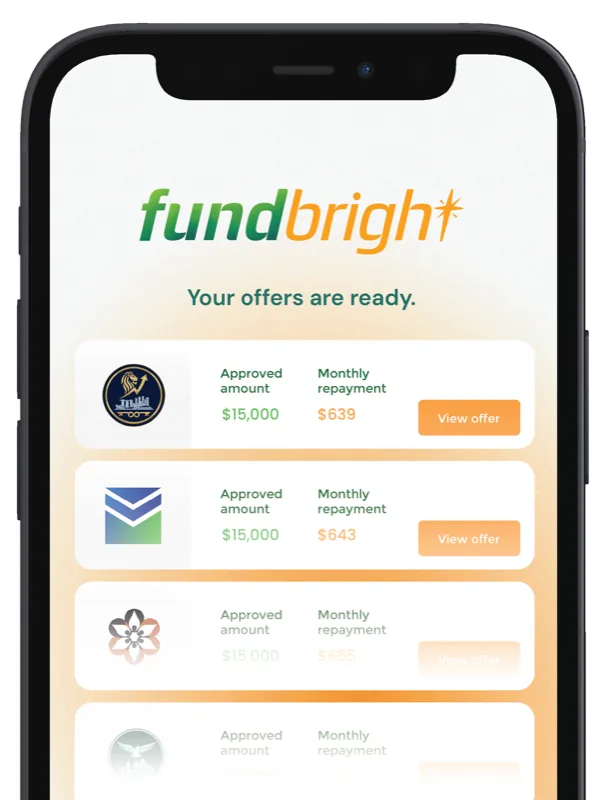
You submit one application with documented income and a single soft enquiry. FundBright routes the application to licensed moneylenders in its network. Each lender sees the full debt picture and quotes a consolidation rate. The lender that quotes a lower rate pays FundBright a lower commission, so the lender has a structural reason to offer below ceiling.
The winning lender disburses a consolidation facility that pays off the borrower’s existing licensed-lender obligations. The borrower moves from multiple payments at the ceiling to one payment below it.
The matched lender completes the in-person identity verification required by the MinLaw Registrar’s Directions: a licensed moneylender must verify the borrower’s identity by meeting the borrower in person at the licensed moneylender’s approved place of business before granting any loan.
FundBright facilitates scheduling and captures final disbursed terms from both lender and borrower. That closed loop is the enforcement mechanism for the inverse commission model. Without it, inverse commission collapses back into flat-fee economics.
Best offer wins. No priority, no favourites. You stay in control.
Can money lenders offer debt consolidation plans?
Licensed moneylenders do not offer ‘DCP’ per se. DCP is a bank-specific product under MAS Notice 635. Licensed moneylenders offer consolidation facilities that achieve the same outcome: multiple debts rolled into one repayment at a lower rate. FundBright compares these offers across its network.
4. Who This Is For (and Who It Is Not For)
FundBright debt consolidation routes borrowers only to licensed moneylenders under the Moneylenders Act Cap. 188 and never to unlicensed lenders or loan sharks.
Who FundBright debt consolidation is built for
Borrowers managing two or more licensed-lender obligations simultaneously who want a single consolidated repayment. Borrowers whose aggregate interest-bearing unsecured debt sits below the 12x monthly income floor that bank DCP requires. Borrowers earning S$2,500 to S$7,000 per month who sit below bank-applied income thresholds (commonly S$30,000 at some participating banks; the ABS DCP framework floor is S$20,000) or have profile complications such as high BNPL utilisation, variable income, or stretched DSR.
Who FundBright is NOT for
FundBright does not route to unlicensed lenders or loan sharks. Every lender in the network holds a current Moneylenders Act Cap. 188 licence. Borrowers at or above the aggregate loan limit (6x monthly income) are declined. Borrowers whose aggregate interest-bearing unsecured debt exceeds 12x monthly income should check bank DCP eligibility, subject to the bank’s income requirements and other criteria. No rerouting, no creative structuring. The cap is the cap. No offshore or cross-border lending.
Required documents
- Latest 3 months’ payslips or income documentation
- CPF contribution history
- MLCB check
- List of existing loan obligations
- NRIC
What happens if I am already at my 6x monthly income aggregate loan limit?
New borrowing on top of your existing licensed-lender debts is declined. The 6x monthly income cap is enforced across every licensed lender at any one time, and FundBright cannot reroute around it.
Consolidation that refinances those existing debts is allowed. The new facility pays off the existing loans simultaneously, so your aggregate stays at or below 6x throughout the swap. The cap is preserved, not exceeded.
5. Compliance: MinLaw and Borrower Safety
FundBright debt consolidation operates within the Moneylenders Act Cap. 188 permitted-fees schedule, with every lender holding a current Moneylenders Act Cap. 188 licence and every transaction verified in person.
Every lender in the FundBright network holds a licence under the Moneylenders Act Cap. 188. The Act, administered by the MinLaw Registrar of Moneylenders, sets the permitted fees, interest charges, and aggregate loan limit for every loan in the network:
| Permitted fee | Cap |
|---|---|
| Interest | 4% p.m. |
| Late interest | 4% p.m. |
| Late fee | S$60 per month |
| Admin fee | 10% of principal |
| Total cap (interest + fees) | 100% of principal |
| Aggregate loan limit | 6x monthly income (MLCB-enforced) |
FundBright charges the borrower nothing. No comparison fee, no application fee, no processing fee, no success fee. FundBright is paid by the lender on disbursement.
The soft enquiry at the comparison stage does not trigger a hard pull. Once disbursed, the consolidated facility replaces the individual debts on your credit record.
Under the MinLaw Registrar’s Directions, a licensed moneylender must verify the borrower’s identity by meeting the borrower in person at the licensed moneylender’s approved place of business before granting any loan.
A loan transaction cannot be completed fully online because the borrower must be met in person at the licensed moneylender’s approved place of business. That is not a FundBright requirement. It is what separates a licensed moneylender from an unlicensed lender. Read more in what licensed lenders can and cannot do.
Will applying or comparing on FundBright affect my credit profile?
No. FundBright runs one soft enquiry at the comparison stage. A soft enquiry does not affect your credit profile. A hard pull happens only when you provide consent, during your in-person appointment at the lender’s approved place of business.
6. Bank DCP vs Licensed Moneylender Consolidation via FundBright
Bank DCP and FundBright moneylender consolidation serve the same borrower intent (one repayment, lower rate) but operate under different regulatory frameworks with different eligibility rules.
| Comparison criteria | Bank DCP (MAS Notice 635) | FundBright Consolidation |
|---|---|---|
| Entry rule | Aggregate unsecured debt must exceed 12x monthly income | Aggregate within the 6x licensed-lender cap |
| Annual income threshold | S$20,000 (ABS framework); S$30,000 at some banks | No bank minimum; assessed on documented income |
| Who qualifies | Borrowers in severe distress above the 12x floor | Near-prime borrowers below the DCP floor |
| Lender incentive | Standard bank spread; no structural undercut | Inverse commission — lower rate = lower commission |
| Credit enquiry | Hard pull per bank application | One soft enquiry across the network |
| Disbursement | Bank disburses to creditors directly | Lender disburses consolidation facility to pay off existing obligations |
| Regulatory framework | MAS Notice 635 / ABS DCP framework | Moneylenders Act Cap. 188 |
Bank DCP requires aggregate interest-bearing unsecured debt exceeding 12x income — the entry floor — which excludes the borrowers between bank approval and the licensed-lender ceiling that this page serves. FundBright moneylender consolidation operates under the standard 6x monthly income cap, which serves the segment DCP cannot reach. Inverse commission is the structural mechanism absent from both bank DCP and flat-commission platforms.
What is the difference between a bank DCP and moneylender consolidation?
DCP is a bank product governed by MAS Notice 635 and the ABS framework. It requires your total unsecured debt to sit above 12x your monthly income before you qualify. Moneylender consolidation via FundBright operates under the Moneylenders Act Cap. 188 and the standard 6x aggregate loan limit. Different regulatory frameworks, different eligibility rules.
7. Compliance and Lender Verification
FundBright’s consolidation model is structurally verifiable through MinLaw licensing records and the signed inverse commission agreements.
Every lender in the network is verifiable on the MinLaw licensed moneylender register. The register is public and updated by the Registrar of Moneylenders. If a lender’s name is not on the register, FundBright does not work with that lender.
A borrower between bank approval and the licensed-lender ceiling, earning S$3,500 per month, carries three separate licensed-lender obligations totalling S$18,000 at interest rates right at the 4% p.m. ceiling. Their maximum aggregate loan limit across all licensed lenders under the Moneylenders Act is S$21,000 (6x monthly income). While they still have S$3,000 of legal borrowing headroom, they are facing severe cash-flow distress juggling three separate weekly or monthly repayment cycles. However, because their total debt is well below the S$42,000 mark (the 12x entry floor for bank DCP at this income level), they are locked out of bank consolidation.
Through FundBright, their application routes to a single lender in the network who provides a S$18,000 consolidated facility at a projected 2.5–3% p.m. band, paying off the three original moneylenders completely. The borrower moves from three ceiling-rate repayments to a single, lower-interest repayment, remaining fully compliant within their statutory 6x limit.
The same inverse commission structure governs personal loan comparisons — see how inverse commission works for personal loans.
Does FundBright charge me anything?
FundBright charges the borrower nothing. No comparison fee, no application fee, no processing fee, no success fee. FundBright is paid by the lender on disbursement through the inverse commission model.
Ready to find your best rate?
Get My OffersThese might also help

Ready when you are.Ready when you are.
checking will not affect your credit score