
Services
Education Loans
For local university students with a gap beyond HESL, or private university students who don't qualify for government schemes at all, FundBright's inverse commission gives licensed moneylenders a reason to price below the 4% p.m. ceiling.

Introduction
FundBright is a Singapore education loan comparison platform built on inverse commission: licensed lending partners in the network pay a lower fee when they offer you a lower rate. On flat-commission platforms, every lender pays a fixed fee regardless of the rate they offer you, so those lenders tend to price rates at the ceiling.
Where you study changes which financing options are even available. Students at one of the six local autonomous universities (NUS, NTU, SMU, SUTD, SIT, SUSS) or MOE-subsidised polytechnics have access to the Tuition Grant, government bursaries, PSEA, and from 1 July 2026, the new Higher Education Student Loan (HESL). Students at a private education institution (PEI) — SIM, Kaplan, PSB Academy, James Cook, Curtin, and others — generally don't qualify for any of that, because their programmes aren't MOE-subsidised. Whether you're the student or the parent footing the bill, the gap looks different depending on which category you're in, and a licensed moneylender education loan is one option for closing it either way.
1. What is an education loan?
An education loan, in the licensed-moneylender context, is an unsecured personal loan used to cover education-related costs — tuition, living expenses, or both — that aren't met by government schemes or bank education loans. It is governed by the Moneylenders Act Cap. 188 — capped at 4% p.m. interest, a 10% one-off admin fee, and a 6x monthly income aggregate borrowing limit, assessed on the income of whoever is borrowing (the working adult student, or the parent financing a child's education).
What is the Higher Education Student Loan (HESL), and who can use it?
From 1 July 2026, HESL replaces the former Tuition Fee Loan and Study Loan as the main government loan scheme — but only for MOE-subsidised diploma, undergraduate, and postgraduate programmes at government-funded institutions (the local autonomous universities, polytechnics, ITE, and select arts institutions). It covers a percentage of subsidised tuition fees, with a means-tested component covering the remaining balance and a living allowance loan for eligible students. HESL does not apply to private education institutions.
My child is studying at a private university — does HESL or Tuition Grant apply?
No. Private education institutions such as SIM, Kaplan, PSB Academy, James Cook University, and Curtin Singapore are not MOE-subsidised, so students there don't qualify for Tuition Grant, HESL, government bursaries, or PSEA in the way local autonomous university or polytechnic students do. Full programme fees at PEIs commonly run S$20,000 to S$85,000 depending on the institution and course, and financing typically comes from family savings, a bank education loan (where eligible), or a personal loan.
2. When Would You Need an Education Loan?
If you're at a local autonomous university or polytechnic:
- Living expenses or overseas programme costs not covered by HESL, which is primarily tuition-focused
- A timing gap between when fees are due and when HESL, a bursary, or PSEA disbursement clears
- A means test that doesn't qualify you for the full HESL living allowance component
If you're at a private education institution (PEI), or your course is otherwise unsubsidised:
- Tuition fees in full, since PEI programmes don't qualify for Tuition Grant, HESL, bursaries, or PSEA
- A bank education loan application that didn't go through, or doesn't cover the full quantum needed
- Skills upgrading or part-time study where SkillsFuture Credit doesn't cover the full course fee
For parents financing either category:
- A funding gap after government schemes (if applicable) and family savings have been applied, where the parent rather than the student is the one borrowing
3. Alternatives Worth Checking First
| Alternative | What it offers | Limitation |
|---|---|---|
| Tuition Grant Scheme | Government subsidy reducing tuition fees for eligible students at local autonomous universities, polytechnics, ITE, and select arts institutions | Only for MOE-subsidised institutions; doesn't apply to PEIs; doesn't cover living costs |
| Higher Education Student Loan (HESL), from 1 July 2026 | Covers a percentage of subsidised tuition fees; means-tested component covers the remaining balance plus a living allowance loan for eligible students | Only for MOE-subsidised programmes at government-funded institutions; means-tested portions require income assessment |
| Government bursaries | Means-tested cash support; can cover a large share of fees for lower-income households | Only for MOE-subsidised institutions; generally one bursary per academic year |
| Post-Secondary Education Account (PSEA) | Government and family-contributed education savings, usable for tuition and other approved fees | Limited to the accumulated balance; not a source of new funds; only usable at eligible institutions |
| Bank education loan (e.g. OCBC FRANK, POSB Further Study Assist) | Available to both local and PEI students; rates around 4.4–4.5% p.a., loan quantum up to 10x monthly income | Usually requires the borrower (student or parent) to meet income and credit criteria, and often a guarantor; approval isn't guaranteed |
| SkillsFuture Credit | Government credit for approved skills and training courses | Capped quantum; only valid for SkillsFuture-approved courses, not full diploma/degree programmes |
The general sequence: if you're at a government-funded institution, check Tuition Grant, HESL, bursaries, and PSEA first. If you're at a PEI, those don't apply — check a bank education loan first, since rates are typically lower than a licensed moneylender's, before considering FundBright for whatever gap remains.
Does HESL cover living expenses and overseas programmes?
The means-tested component of HESL can include a living allowance loan for eligible students, and for undergraduates, can extend to the cost of overseas student programmes. Eligibility for the means-tested portion depends on household per capita income assessment, so not every student receives the full scope of coverage.
Why would I use a licensed moneylender instead of a bank education loan?
Bank education loans generally carry lower rates and should be checked first. A licensed moneylender loan through FundBright becomes relevant when a bank application wasn't approved, the approved quantum doesn't cover the full gap, or the timeline doesn't fit (bank loans can take longer to process, and fees are sometimes due before approval comes through).
Why not just put tuition or living costs on a credit card?
If a card balance is cleared within the interest-free billing cycle, it costs nothing extra. The problem is what happens when it isn't: the minimum payment due each month is typically a small percentage of the balance — mostly covering that month's interest with only a sliver going to principal — so an unpaid balance can shrink very slowly while interest, at roughly 25–27% per annum, keeps accruing. A semester's worth of fees or living costs left to revolve this way can end up costing substantially more than the original amount.
A fixed-instalment personal loan works differently: the repayment is calculated upfront against the full amount and a fixed rate, over an agreed tenure, so part of every payment reduces the principal from the start, and the total cost is known before you borrow.
4. When a Personal Loan Makes Sense
A licensed-moneylender education loan makes sense when:
- You're at a PEI, where Tuition Grant, HESL, bursaries, and PSEA don't apply at all, and a bank education loan either wasn't approved or doesn't cover the full quantum
- You're at a government-funded institution, you've already checked Tuition Grant, HESL, bursaries, and PSEA, and a genuine gap remains (commonly living costs or overseas programme expenses)
- You need to bridge a timing gap before a confirmed disbursement clears
- Your aggregate licensed-lender borrowing (whether the student's or the parent's) stays within the 6x monthly income cap
It does not make sense to take on a licensed-lender loan before checking eligibility for HESL or a bank education loan first, where applicable — both generally carry more favourable terms than the statutory moneylender ceiling.
5. How FundBright Gets You the Best Rate
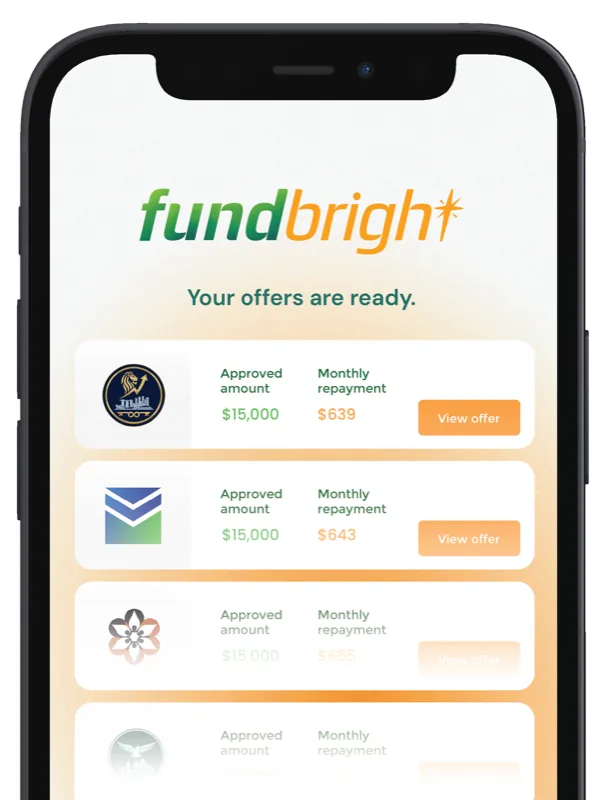
You apply with just your Singpass — no documents needed to get an offer. FundBright runs a single soft enquiry across its network of licensed moneylenders. Because FundBright's commission is inverse — a lower quoted rate means a lower commission paid to FundBright — lenders are rewarded for quoting competitively rather than defaulting to the 4% p.m. ceiling.
The matched lender completes the in-person identity verification required under the MinLaw Registrar's Directions before disbursing the loan. FundBright facilitates scheduling and captures the final disbursed terms.
Best offer wins. No priority, no favourites. You stay in control.
Does FundBright charge me anything?
FundBright charges the borrower nothing. No comparison fee, no application fee, no processing fee, no success fee. FundBright is paid by the lender on disbursement through the inverse commission model.
Will applying or comparing on FundBright affect my credit profile?
No. FundBright runs one soft enquiry at the comparison stage. A soft enquiry does not affect your credit profile. A hard pull happens only when you provide consent, during your in-person appointment at the lender's approved place of business.
6. Who This Is For (and Who It Is Not For)
Who FundBright education loans are built for
Students at private education institutions facing fees that don't qualify for any government scheme, students at government-funded institutions with a genuine gap beyond HESL, and parents financing either — all earning S$2,000 to S$7,000 per month, who want a competitive rate rather than the ceiling rate.
Who FundBright is NOT for
FundBright does not route to unlicensed lenders or loan sharks. Every lender in the network holds a current Moneylenders Act Cap. 188 licence. Borrowers at or above the aggregate loan limit (6x monthly income) are declined. Students at government-funded institutions who haven't yet checked HESL, bursary, or PSEA eligibility should do that first; students or parents considering a bank education loan should compare that rate before applying here.
Required documents (during in-person verification)
You don't need any documents to apply and get an offer — applying through FundBright is done entirely via Singpass. Documents come into play later, when you go in person to the matched lender's approved place of business for identity verification:
- Latest 3 months' payslips or income documentation (of the applicant — student or parent)
- CPF contribution history
- MLCB check
- Course fee schedule or institution invoice
- NRIC verification
Permitted fees and caps
| Permitted fee | Cap |
|---|---|
| Interest | 4% p.m. |
| Late interest | 4% p.m. |
| Late fee | S$60 per month |
| Admin fee | 10% of principal |
| Total cap (interest + fees) | 100% of principal |
| Aggregate loan limit | 6x monthly income (MLCB-enforced) |
Every lender in the FundBright network is verifiable on the public MinLaw licensed moneylender register, administered by the Registrar of Moneylenders.
Is FundBright a licensed moneylender, or a comparison platform?
FundBright is a comparison platform, not a lender. Every lender in the network is a licensed moneylender under the Moneylenders Act Cap. 188. The final loan grant comes from the matched lender, issued in person at the lender's approved place of business. FundBright does not grant loans.
Ready to find your best rate?
Get My OffersThese might also help
Ready when you are.Ready when you are.
checking will not affect your credit score