
Services
Emergency Loans
When the need is urgent and other payment methods fall short, FundBright's inverse commission gives licensed moneylenders a reason to move fast and price below the 4% p.m. ceiling
Introduction
FundBright is a Singapore emergency loan comparison platform built on inverse commission: licensed lending partners in the network pay a lower fee when they offer you a lower rate. On flat-commission platforms, every lender pays a fixed fee regardless of the rate they offer you, so those lenders tend to price rates at the ceiling — exactly the wrong incentive when speed and cost both matter.
An emergency loan is not a separate loan product under Singapore law — it's a personal loan applied to an urgent situation: a sudden bill, an unexpected expense, or an income disruption that can't wait for a bank's decision timeline. The urgency changes the options available to you.
1. What is an emergency loan?
An emergency loan is an unsecured personal loan from a licensed moneylender, used to cover an urgent, often unplanned expense. It is governed by the Moneylenders Act Cap. 188 — the same 4% p.m. interest cap, 10% one-off admin fee, and 6x monthly income aggregate limit apply as with any licensed-lender loan. There's no separate "emergency" category with different legal terms; what differs is how quickly the comparison and disbursement happen.
How fast can I get an emergency loan in Singapore?
Comparison and quoting through a platform like FundBright typically returns offers within 24 hours of submission. Final disbursement still requires the in-person identity verification mandated by the MinLaw Registrar's Directions — that step cannot be skipped, even for urgent needs, because it's what separates a licensed moneylender from an unlicensed one.
2. When Would You Need an Emergency Loan?
- Sudden medical costs not fully covered by insurance, MediSave, or subsidies, requiring quick out-of-pocket payment
- Urgent home repairs (burst pipe, electrical fault) that can't be delayed
- Loss of income from sudden job loss, retrenchment, or reduced work hours
- A family emergency requiring urgent travel or unplanned expense
- A bill or obligation with a hard deadline and insufficient savings to cover it
The common thread is urgency plus a funding gap — not necessarily severe financial hardship. That distinction matters for which alternatives are worth checking first.
3. Why Other Payment Methods Sometimes Fall Short
When an emergency hits, the first instinct is usually to reach for whatever's already available — savings, a credit card, family, or an employer advance. Each of these can work, but each has a real limitation worth knowing before you rely on it:
| Option | Why it helps | Where it falls short |
|---|---|---|
| Savings | No interest, no application, immediate | Often the first thing depleted by the emergency itself, or not enough to fully cover it |
| Credit card | Instant access if a card is already held | Retail interest of roughly 25.9%–26.9% p.a. (up to 29.9% p.a. overdue) makes it expensive if the balance isn't cleared quickly; also has its own credit limit |
| Employer salary advance | Interest-free, no fresh application | Not every employer offers this, and it's usually capped at about one month's pay |
| Family or friends | No interest, flexible | Not always available, and borrowing from people close to you carries its own relational cost |
| Insurance or compensation payout | Can fully cover the cost if eligible | Processing takes time — often longer than the emergency itself allows, and payment is needed now, not after a claims review |
The common pattern: most "free" options are either limited in size, slow to arrive, or already exhausted by the time an emergency happens. A licensed moneylender loan is comparatively fast and has a known, capped cost — which is why it's worth comparing properly rather than defaulting to whichever option is most convenient in the moment.
Why not just put it on a credit card?
If you can clear the balance within the interest-free billing cycle, a credit card costs nothing extra and is the cheapest option. The risk is that emergencies are, by definition, unplanned — and a balance that doesn't get cleared in time starts accruing interest at roughly 25–27% per annum, climbing further if the account falls overdue. A licensed moneylender loan, capped at 4% per month under the Moneylenders Act, comes with a fixed repayment schedule agreed upfront, so the total cost is known before you borrow.
Why does a revolving credit card balance end up costing so much more?
On a credit card, the minimum payment due each month is typically a small percentage of the outstanding balance — often just enough to cover that month's interest plus a sliver of principal. Whatever principal remains keeps accruing interest, and if you only ever pay the minimum, the balance shrinks very slowly.
A fixed-instalment personal loan works differently: each monthly payment is calculated upfront against the full principal and a fixed rate, over an agreed tenure, so a defined portion of every payment goes to principal from day one. The total interest you'll pay is fixed and disclosed before you borrow. For an emergency expense you didn't plan for, knowing the exact payoff date and total cost upfront is often as valuable as the lower rate itself.
4. When a Personal Loan Makes Sense
A licensed-moneylender emergency loan makes sense when:
- You have a stable, documented income and can service the repayment
- The need is genuinely time-sensitive, and the no-cost options (savings, employer advance, insurance) either aren't enough or won't arrive in time
- You'd rather have a fixed, known repayment cost than let the expense sit on a revolving credit card balance
- Your aggregate licensed-lender borrowing stays within the 6x monthly income cap after the new loan
It does not make sense to borrow more than the gap actually requires — check what savings, employer support, or insurance can cover first, since every dollar from those sources is a dollar you don't need to finance.
5. How FundBright Gets You the Best Rate, Fast
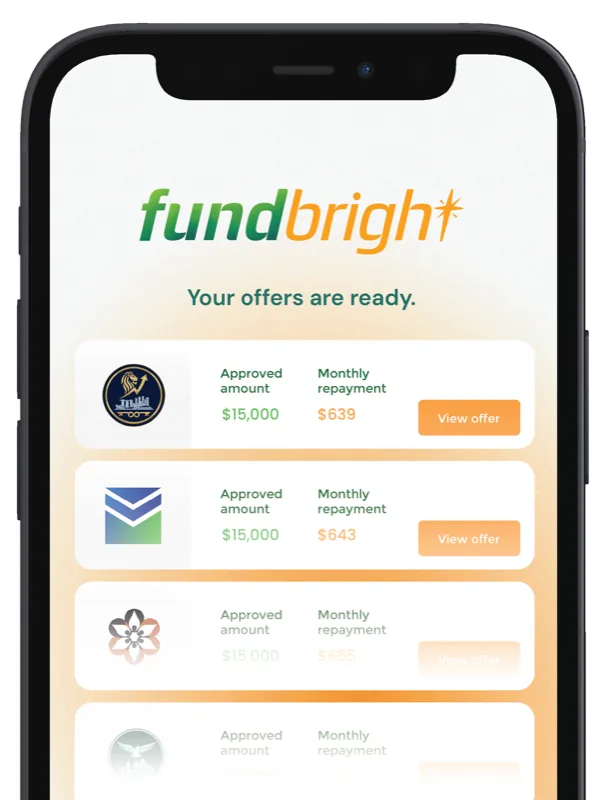
You apply with just your Singpass — no documents needed to get an offer. FundBright runs a single soft enquiry across its network of licensed moneylenders, and offers typically return within 24 hours. Because FundBright's commission is inverse — a lower quoted rate means a lower commission paid to FundBright — lenders are rewarded for quoting competitively rather than defaulting to the 4% p.m. ceiling.
The matched lender still completes the in-person identity verification required under the MinLaw Registrar's Directions before disbursing. FundBright facilitates scheduling to keep that step as fast as possible.
Best offer wins. No priority, no favourites. You stay in control.
Does FundBright charge me anything?
FundBright charges the borrower nothing. No comparison fee, no application fee, no processing fee, no success fee. FundBright is paid by the lender on disbursement through the inverse commission model.
Will applying or comparing on FundBright affect my credit profile?
No. FundBright runs one soft enquiry at the comparison stage. A soft enquiry does not affect your credit profile. A hard pull happens only when you provide consent, during your in-person appointment at the lender's approved place of business.
6. Who This Is For (and Who It Is Not For)
Who FundBright emergency loans are built for
Borrowers earning S$2,000 to S$7,000 per month facing a time-sensitive expense, who have a stable income to service repayment but need funds faster than a bank's standard underwriting timeline allows.
Who FundBright is NOT for
FundBright does not route to unlicensed lenders or loan sharks. Every lender in the network holds a current Moneylenders Act Cap. 188 licence. Borrowers at or above the aggregate loan limit (6x monthly income) are declined.
Required documents (during in-person verification)
You don't need any documents to apply and get an offer — applying through FundBright is done entirely via Singpass. Documents come into play later, when you go in person to the matched lender's approved place of business for identity verification:
- Latest 3 months' payslips or income documentation
- CPF contribution history
- MLCB check
- NRIC verification
Permitted fees and caps
| Permitted fee | Cap |
|---|---|
| Interest | 4% p.m. |
| Late interest | 4% p.m. |
| Late fee | S$60 per month |
| Admin fee | 10% of principal |
| Total cap (interest + fees) | 100% of principal |
| Aggregate loan limit | 6x monthly income (MLCB-enforced) |
Every lender in the FundBright network is verifiable on the public MinLaw licensed moneylender register, administered by the Registrar of Moneylenders.
Is FundBright a licensed moneylender, or a comparison platform?
FundBright is a comparison platform, not a lender. Every lender in the network is a licensed moneylender under the Moneylenders Act Cap. 188. The final loan grant comes from the matched lender, issued in person at the lender's approved place of business. FundBright does not grant loans.
Ready to find your best rate?
Get My OffersThese might also help
Ready when you are.Ready when you are.
checking will not affect your credit score