
Services
Medical Loans
When MediSave and insurance don't close the full gap, FundBright's inverse commission gives licensed moneylenders a reason to offer rates below the 4% p.m. ceiling.
Introduction
FundBright is a Singapore medical loan comparison platform built on inverse commission: licensed lending partners in the network pay a lower fee when they offer you a lower rate. On flat-commission platforms, every lender pays a fixed fee regardless of the rate they offer you, so those lenders tend to price rates at the ceiling — the opposite of what you want when you're already managing a medical bill.
Most working adults in Singapore have some combination of MediSave and MediShield Life (or a private Integrated Shield Plan on top). That's a meaningful layer of protection, but it isn't always a complete one. Withdrawal limits, claim caps, deductibles, and co-insurance mean a real out-of-pocket gap can still show up even when every policy and account is in good standing. A medical loan through a licensed moneylender is a tool for that gap — not a substitute for MediSave or insurance, but the financing option for whatever they don't reach.
1. What is a medical loan?
A medical loan is an unsecured personal loan from a licensed moneylender, used to cover medical expenses that MediSave and insurance don't fully close. It is governed by the Moneylenders Act Cap. 188 — capped at 4% p.m. interest, a 10% one-off admin fee, and a 6x monthly income aggregate borrowing limit. It is not a healthcare-specific product with different statutory terms; it's a personal loan applied to a medical expense.
Is a medical loan the same as MediSave or MediShield Life?
No. MediSave is your own compulsory savings, withdrawn to pay approved medical expenses. MediShield Life is mandatory basic health insurance covering large hospital bills and selected costly outpatient treatments. A medical loan from a licensed moneylender is borrowed money — it makes sense only for the portion of a bill that MediSave, MediShield Life, and any private insurance genuinely don't cover.
2. When Would You Need a Medical Loan?
- Your MediSave withdrawal limit for a specific treatment type has been reached, but the bill isn't fully settled
- Your insurance payout is reduced by a deductible, co-insurance, or a claim limit, leaving a balance you weren't expecting
- The treatment, ward class, or provider isn't covered (or fully covered) by your MediShield Life or Integrated Shield Plan
- Fertility treatment, where MediSave's lifetime cap rarely covers the full cost of more than one or two cycles
- Aesthetic or cosmetic treatment, which MediSave and insurance exclude entirely
- You're waiting on an insurance reimbursement, but the hospital or clinic wants payment now
- A dependant's medical costs come up and your own MediSave withdrawal limits for that relationship have already been used
3. Why MediSave and Insurance May Not Cover Everything
| Layer | What it covers | Where the gap shows up |
|---|---|---|
| MediSave | Your own savings, withdrawable for approved hospitalisation, day surgery, and certain outpatient treatments (including for immediate family) | Subject to withdrawal limits per treatment type — once the limit for that category is reached, the rest is out of pocket |
| MediShield Life | Mandatory basic insurance for large hospital bills and selected costly outpatient treatments | Payouts are pegged to subsidised (Class B2/C) ward benchmarks, and are subject to claim limits, deductibles, and co-insurance — staying in a higher ward class or private hospital means MediShield Life covers a smaller share of the actual bill |
| Integrated Shield Plan (private add-on) | Higher claim limits and coverage for private hospital and higher ward class care | Still has its own deductible and co-insurance (commonly a percentage of the bill above the deductible, sometimes capped by a rider); elective and non-panel treatments can fall outside the policy entirely |
None of this means MediSave and insurance "don't work" — for most hospitalisations, they cover the bulk of the bill. It just means a real, sometimes sizeable, gap can remain even for someone who is fully covered on paper.
I have insurance — why am I still facing a bill?
Even a good Integrated Shield Plan typically leaves a deductible and a co-insurance percentage for you to pay, and that co-insurance portion can sometimes be covered by a separate rider — if you didn't take one up, it comes out of pocket. Ward class upgrades, treatments outside the policy's panel, and procedures considered elective rather than medically necessary are other common places where "covered" doesn't mean "fully covered."
4. Fertility Treatment: Cost, Cycles, and What MediSave Covers
Fertility treatment is a category where the financial picture is genuinely different from most other medical costs, for two reasons: the cost per attempt is high, and more than one attempt is often needed.
A single IVF cycle in Singapore typically costs S$10,000 to S$20,000 at a private clinic, or roughly S$12,000 to S$18,000 at a public hospital, covering consultation, medication, egg retrieval, fertilisation, and embryo transfer. Medication alone can account for S$3,000 to S$8,000 of that, depending on the stimulation protocol.
Success rates per cycle vary meaningfully by age: roughly 40–50% for women under 35, dropping to 30–40% for ages 35–40, and 10–20% for women over 40. Because no single cycle guarantees a result, many couples need more than one attempt.
| Support | What it covers | Limitation |
|---|---|---|
| MediSave (Assisted Conception Procedures) | Withdrawal towards IVF and related procedures | Lifetime cap of S$15,000 per patient, with per-cycle limits that decrease for later cycles |
| Government co-funding | Up to roughly 75% co-funding at public hospitals (KKH, NUH, SGH) for eligible couples | Public hospitals only — not available at private clinics; eligibility depends on the female spouse's age and other criteria; longer waiting times than private |
Even with MediSave and co-funding fully applied, a couple needing two or three cycles at a private clinic can realistically face S$20,000 to S$50,000 or more in out-of-pocket cost across the full journey. Financing one cycle at a time, with a fixed, known repayment, rather than depleting savings unpredictably, is exactly where a personal loan's predictability is useful.
How many IVF cycles does it typically take to get pregnant?
It varies significantly by age and individual circumstances. Singapore data shows success rates decline with each additional cycle, and beyond the third cycle, success rates drop to under 5% based on local figures — which is also why MediSave's structure provides decreasing support for later cycles rather than unlimited funding.
Does MediSave cover the full cost of IVF?
No. MediSave has a lifetime cap of S$15,000 per patient for Assisted Conception Procedures, with the amount available decreasing for later cycles. Even on a single cycle costing S$10,000 to S$20,000, MediSave typically covers only part of it, and government co-funding (where eligible, at public hospitals) helps further — but most couples, especially those needing more than one cycle or treating at a private clinic, still face a meaningful out-of-pocket balance.
5. Aesthetic Treatments: Why Insurance and MediSave Don't Apply
Aesthetic and cosmetic procedures are elective by definition, which means MediSave, MediShield Life, and Integrated Shield Plans generally don't cover them at all. That makes aesthetic work one of the clearest cases where the full cost is genuinely out of pocket from the start.
| Treatment | Typical cost range |
|---|---|
| Botox | A few hundred dollars per area |
| Dermal fillers | S$600–S$1,200 per syringe |
| HIFU (skin tightening) | S$800–S$2,500 per session |
| Laser facials / pico laser | S$200–S$900 per session |
| Skin boosters | S$500–S$1,200 per session |
| Dental veneers (composite) | S$250–S$1,500 per tooth |
| Dental veneers (porcelain) | S$1,000–S$2,500 per tooth |
Many of these treatments also require multiple sessions, so the total cost is often a multiple of the single-session price quoted. Since there's no MediSave or insurance contribution to offset against, the entire amount is a financing decision from day one — which is exactly the kind of clearly defined cost a fixed-rate personal loan suits well.
Can I use MediSave for aesthetic or cosmetic procedures?
No. MediSave withdrawal is restricted to approved medically necessary treatment. Cosmetic and aesthetic procedures — fillers, Botox, laser treatments, veneers for purely cosmetic reasons, and similar — are excluded by design, regardless of the provider or clinic.
6. Why a Personal Loan Beats Rolling the Bill on a Credit Card
A common instinct when a medical bill lands is to put it on a credit card and pay it down over time. The problem is what "over time" actually costs. Credit card retail interest in Singapore runs at roughly 25.9% to 26.9% per annum on a revolving balance, climbing to around 29.9% per annum if the account falls overdue — and that interest compounds on whatever balance remains each month, with no fixed end date unless you commit to a specific repayment amount.
A licensed moneylender personal loan, by contrast, is capped at 4% per month under the Moneylenders Act, with a fixed monthly instalment and a fixed tenure agreed upfront. You know the total cost before you borrow, and the bill is fully resolved with the hospital or clinic immediately rather than carried as an open-ended card balance.
| Row label | Credit card (revolving) | Licensed moneylender personal loan |
|---|---|---|
| Rate | ~25.9–26.9% p.a. (up to ~29.9% p.a. overdue) | Capped at 4% p.m. (48% p.a.); FundBright targets below that via inverse commission |
| Repayment structure | Minimum payment due monthly; balance and interest compound if not cleared | Fixed instalment, fixed tenure, agreed upfront |
| Total cost | Open-ended — depends entirely on how fast you pay it down | Known in advance |
| Hospital/clinic relationship | Bill is settled immediately via the card; debt then sits with the card issuer | Same — bill is settled immediately; loan and bill are separate |
If you can clear a card balance within the interest-free period, that's the cheapest option. If you can't, a fixed-rate, fixed-term personal loan is structurally the more predictable and often cheaper way to finance the gap.
Why does a revolving credit card balance end up costing so much more?
The difference comes down to what each repayment actually pays down. On a credit card, the minimum payment due each month is typically a small percentage of the outstanding balance — often just enough to cover that month's interest plus a sliver of principal. Whatever principal remains keeps accruing interest, so if you only pay the minimum, the balance shrinks very slowly while the interest charge resets every month. A medical bill of a few thousand dollars left to revolve this way can end up costing far more in interest than the original bill, over a long and uncertain payoff timeline.
A fixed-instalment personal loan works differently: each monthly payment is calculated upfront against the full principal and a fixed rate, over an agreed tenure, so a defined portion of every payment goes toward principal from day one. The loan is fully repaid by a known date, and the total interest is fixed and disclosed before you borrow — there's no scenario where the balance lingers indefinitely because you've only been covering the interest.
Is it better to pay a medical bill with a credit card or a personal loan?
If you can pay off the card balance in full within the interest-free billing cycle, the card costs nothing extra. If you can't — and most people facing an unplanned medical bill can't clear it in one cycle — a personal loan's fixed rate and fixed repayment schedule is usually cheaper and more predictable than letting a card balance revolve at upwards of 25% per annum.
7. When a Personal Loan Makes Sense
A licensed-moneylender medical loan makes sense when:
- You've checked your MediSave withdrawal limit and insurance payout (including any deductible and co-insurance) and a genuine shortfall remains
- The alternative is letting the bill sit on a revolving credit card balance at 25%+ per annum with no fixed payoff date
- The payment is time-sensitive — due before a procedure, before discharge, or before an insurance reimbursement clears
- Your aggregate licensed-lender borrowing stays within the 6x monthly income cap
It does not make sense to over-borrow beyond the actual gap — always check your MediSave balance and insurance payout first, since every dollar covered there is a dollar you don't need to finance.
8. How FundBright Gets You the Best Rate
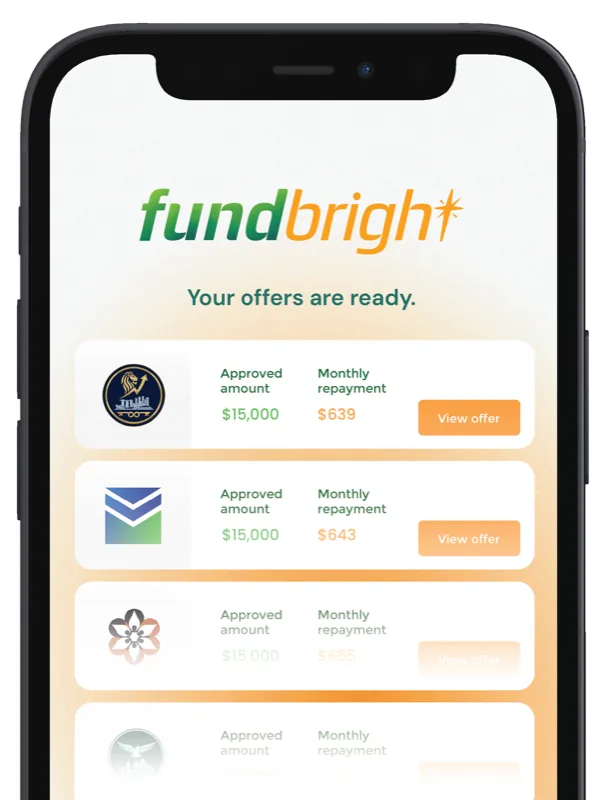
You apply with just your Singpass — no documents needed to get an offer. FundBright runs a single soft enquiry across its network of licensed moneylenders. Because FundBright's commission is inverse — a lower quoted rate means a lower commission paid to FundBright — lenders are rewarded for quoting competitively rather than defaulting to the 4% p.m. ceiling.
The matched lender completes the in-person identity verification required under the MinLaw Registrar's Directions before disbursing the loan. FundBright facilitates scheduling and captures the final disbursed terms.
Best offer wins. No priority, no favourites. You stay in control.
Does FundBright charge me anything?
FundBright charges the borrower nothing. No comparison fee, no application fee, no processing fee, no success fee. FundBright is paid by the lender on disbursement through the inverse commission model.
Will applying or comparing on FundBright affect my credit profile?
No. FundBright runs one soft enquiry at the comparison stage. A soft enquiry does not affect your credit profile. A hard pull happens only when you provide consent, during your in-person appointment at the lender's approved place of business.
9. Who This Is For (and Who It Is Not For)
Who FundBright medical loans are built for
Borrowers earning S$2,000 to S$7,000 per month with a genuine medical-cost shortfall after MediSave and insurance have been applied, who need the remainder financed at a competitive, fixed rate rather than left to revolve on a credit card.
Who FundBright is NOT for
FundBright does not route to unlicensed lenders or loan sharks. Every lender in the network holds a current Moneylenders Act Cap. 188 licence. Borrowers at or above the aggregate loan limit (6x monthly income) are declined. If you haven't yet checked your MediSave withdrawal limit or insurance payout for the bill in question, do that first — it may close some or all of the gap.
Required documents (during in-person verification)
You don't need any documents to apply and get an offer — applying through FundBright is done entirely via Singpass. Documents come into play later, when you go in person to the matched lender's approved place of business for identity verification:
- Latest 3 months' payslips or income documentation
- CPF contribution history
- MLCB check
- Medical bill or treatment cost estimate
- NRIC verification
Permitted fees and caps
| Permitted fee | Cap |
|---|---|
| Interest | 4% p.m. |
| Late interest | 4% p.m. |
| Late fee | S$60 per month |
| Admin fee | 10% of principal |
| Total cap (interest + fees) | 100% of principal |
| Aggregate loan limit | 6x monthly income (MLCB-enforced) |
Every lender in the FundBright network is verifiable on the public MinLaw licensed moneylender register, administered by the Registrar of Moneylenders.
Is FundBright a licensed moneylender, or a comparison platform?
FundBright is a comparison platform, not a lender. Every lender in the network is a licensed moneylender under the Moneylenders Act Cap. 188. The final loan grant comes from the matched lender, issued in person at the lender's approved place of business. FundBright does not grant loans.
Ready to find your best rate?
Get My OffersThese might also help
Ready when you are.Ready when you are.
checking will not affect your credit score