
Knowledge
CPF Personal Loan Explained: Why Your CPF Stays Out of Borrowing, and What Covers the Gap
CPF personal loan Singapore: why CPF savings stay out of any loan, what each CPF account pays for in 2026, and how to fund the costs CPF leaves out.
No CPF personal loan exists, because CPF Board grants no personal loans and the CPF Act protects your CPF savings from creditors' claims, so those savings do not serve as security for any loan. What CPF does pay for in 2026 depends on the account, and costs outside those uses fall to your own savings, a government scheme or a personal loan.
What CPF Covers, and What It Does Not
CPF savings pay for set uses: housing, insurance, investment, healthcare, approved education and retirement. The CPF Act protects them from creditors' claims, so they do not back a personal loan, and other cash needs call for another source.
CPF Board lists housing, insurance, investment and education as Ordinary Account uses, while MediSave pays hospitalisation expenses and approved medical insurance.
Table: what CPF pays for, and alternatives to a CPF Personal Loan
| Need | CPF account | Allowed? | Rule | Alternative |
|---|---|---|---|---|
| Home purchase | Ordinary Account | Yes | Housing is a listed Ordinary Account use | Cash for any amount above CPF housing limits |
| Hospital bill | MediSave | Yes, up to limits | Ward charges up to S$1,130 a day for the first two days, then S$400; operation caps up to S$5,290 | Cash or a personal loan for the amount above the limits |
| Local tuition | Ordinary Account, through the CPF Education Loan Scheme | Yes, repaid with interest | Up to 40% of Ordinary Account savings; repaid within 12 years | MOE Higher Education Student Loan; a personal loan for costs outside tuition |
| Wedding | None | No | No CPF scheme lists it | Savings or a personal loan |
| Travel | None | No | No CPF scheme lists it | Savings or a personal loan |
| Card debt | None | No | CPF Board does not release savings in a lump sum to settle debts | Debt consolidation or a structured repayment plan |
Does CPF fund a personal loan?
No. CPF Board runs no personal loan, and it does not release CPF savings in a lump sum to pay off a debt, so any personal loan you take rests on your income instead.
Why CPF Savings Stay Outside a Loan
The CPF Act protects CPF savings from creditors' claims, and CPF withdrawal rules hold savings for housing, healthcare, education and retirement, so a lender neither takes CPF as security nor claims repayment from it. CPF savings are ring-fenced by law for housing, healthcare and retirement and stay outside any personal loan, so the loan covers the gap CPF keeps locked. A search for a CPF personal loan is a search for cash that CPF rules hold back, and the real decision is how to fund that gap at the lowest cost.
The protection on CPF savings
CPF savings sit beyond the reach of your creditors. CPF Board's answer on paying off debt with CPF states that CPF monies "are protected under the CPF Act from claims by creditors", so that debts do not drain the savings you need in retirement. CPF Board tells creditors not to expect members to settle debts from CPF, and points members to Credit Counselling Singapore, negotiating with creditors, the Debt Repayment Scheme or bankruptcy.
Section 24 of the CPF Act on Singapore Statutes Online sets out the same protection in law: since the 2013 amendment, a member's CPF savings do not pass to the Official Assignee on bankruptcy. CPF Board's annex on the CPF Investment Scheme adds that investments made with CPF savings "cannot be assigned, pledged or used as collateral".
The withdrawal rules by account and age
Before 55, while you remain a Singapore Citizen or PR, CPF Board allows a withdrawal only on medical grounds. From 55 to 64, you withdraw up to S$5,000 from your Ordinary Account, and any amount from it once you have set aside the Full Retirement Sum, which is S$220,400 for members turning 55 in 2026.
What lenders look at instead
Lenders assess your income and your existing debts, not a CPF balance. CPF contribution history is one record of employment income, and Singpass's Myinfo service carries up to 15 months of it from CPF Board, covering employment contributions only, as the Myinfo data catalogue for finance shows. FundBright's application is designed to pull it through Singpass with your consent, together with your income, employment type and Notice of Assessment. FundBright collects this verified data at the start, so lenders see a fuller picture of your income before they make an offer.
For licensed moneylenders, your income also sets the aggregate limit on unsecured loans across all licensed moneylenders combined: 6x your monthly income once your annual income reaches S$20,000. Your income, not your CPF, carries the loan, and the rules on that loan depend on who lends it, so check what counts as a personal loan and which type of lender, a bank or a licensed moneylender, offers it before you weigh one offer against another.
Where CPF Sits Among Ways to Pay for Big Costs
Besides your own savings, CPF is one of five common ways to fund a large cost in Singapore, alongside the CPF Education Loan Scheme, MOE's Higher Education Student Loan, a bank personal loan and a licensed-moneylender loan. CPF savings and the two education schemes serve set purposes, as CPF Board's guide for fresh graduates shows for the Ordinary Account, while both loans serve any purpose.
| Option | Run by | What it pays for | Repay? | Interest | When it fits |
|---|---|---|---|---|---|
| CPF account savings | CPF Board | Listed CPF uses only | No (your own savings) | Not applicable | The cost is a listed CPF use |
| CPF Education Loan Scheme | CPF Board | Subsidised tuition fees for a full-time MOE-subsidised diploma or degree | Yes, in cash within 12 years, from one year after the course | Prevailing CPF interest rate | Family Ordinary Account savings are available |
| MOE Higher Education Student Loan | MOE, through DBS or OCBC | Up to 90% of subsidised tuition fees, plus a means-tested provision for a living allowance (and, for Singapore Citizens, the remaining fees) within MOE's household income limits | Yes, over up to 10 years | Interest-free during study; charged from graduation | The student is in an MOE-subsidised course |
| Bank personal loan | Banks, regulated by MAS | Any purpose | Yes, fixed instalments | EIR shown in the bank advert | Your income meets the bank's minimum |
| Licensed-moneylender loan | Licensed moneylenders, regulated by MinLaw | Any purpose | Yes, fixed instalments (the Registry's borrower guide states no maximum tenure) | Up to 4% p.m. interest and a fee of up to 10%; EIR depends on tenure and fees | The bank route is closed or too slow |
The MOE Higher Education Student Loan terms set a maximum repayment period of 10 years, and earlier Tuition Fee Loan borrowers keep their existing loans.
Is the CPF Education Loan Scheme a loan?
Yes, the CPF Education Loan Scheme works as a loan in effect, because the student repays the CPF savings used, plus interest at the prevailing CPF interest rate from the date of deduction, in cash into the payer's Ordinary Account. Under CPF Board's terms for the CPF Education Loan Scheme, repayment starts one year after the course ends or the student leaves, runs at a minimum of S$100 a month and finishes within 12 years. The member whose Ordinary Account pays, for their own course or for a child, spouse or relative, draws up to 40% of accumulated Ordinary Account savings, less amounts already used, or the Ordinary Account balance after housing set-asides, whichever is lower.
Key Rules Behind Each CPF Account
Each CPF account has its own purpose and withdrawal rules, and the age of 55 changes them: the Special Account closes and the Retirement Account opens.
Ordinary Account (housing, insurance, investment, education)
The Ordinary Account pays for housing, insurance such as the Dependants' Protection Scheme, investment and education. Ordinary Account savings earn 2.5% p.a. (October to December 2026). Under CPF Board's rules on withdrawals from age 55 to 64, you withdraw up to S$5,000 from your Ordinary Account whatever your balances, and any amount from it once you have set aside the Full Retirement Sum.
MediSave (healthcare, with withdrawal limits per treatment)
MediSave pays healthcare costs only within set limits. CPF Board's MediSave withdrawal limits from 1 April 2025 allow up to S$1,130 a day in ward charges for the first two days of a stay, then S$400 a day, up to S$830 a day for day surgery, and between S$240 and S$5,290 for an operation, depending on the procedure. MediSave also pays MediShield Life premiums.
Special Account before 55, Retirement Account from 55
Before 55, the Special Account holds your retirement savings and investments, with limited uses. The Special Account closed for members aged 55 and above on 19 January 2025, as CPF Board's news release on the Special Account closure sets out. At 55, Special Account savings move first into a new Retirement Account, followed by Ordinary Account savings, up to your cohort's Full Retirement Sum, and any Special Account remainder moves to the Ordinary Account at 2.5% p.a.
CPF Board's retirement planning guide sets the sums for members turning 55 in 2026 at S$110,200 (Basic), S$220,400 (Full) and S$440,800 (Enhanced). The Retirement Account funds CPF LIFE monthly payouts, which start at 65 for members born in 1954 or later.
Does CPF release savings early in an emergency?
CPF Board releases savings early, before 55 and while you remain a Singapore Citizen or PR, only on medical grounds: a condition that shortens life expectancy, permanent unfitness for work or a permanent lack of mental capacity. CPF Board does not release CPF savings to tide over financial difficulty, and points members instead to MediFund, Workfare Income Supplement, Silver Support, GST Vouchers and the nearest Social Service Office.
When CPF Is Locked and You Need Cash
Your own savings, a government scheme or a personal loan fills the gap when CPF rules exclude your need. Savings come first; after that, public schemes with set purposes cover some costs and a loan for any purpose covers the rest.
Education costs CPF does not cover
The CPF Education Loan Scheme pays subsidised tuition fees only, and CPF Board's scheme terms limit it to full-time MOE-subsidised diploma and degree courses. MOE's Higher Education Student Loan also covers MOE-subsidised courses only and pays a living allowance only through its means-tested provision, so private courses fall outside both schemes, and living costs and course materials fall outside the CPF scheme. For the costs outside tuition, look at a personal loan for education sized to the gap the two schemes leave.
Medical costs above MediSave limits
MediSave pays a hospital bill only within its per-day and per-operation limits, so any amount above those limits falls to cash or a loan. For patients who still struggle to pay, CPF Board's answer on financial difficulties points to MediFund.
Take a S$10,000 medical bill funded by a loan approved for S$10,000 with a 10% upfront admin fee: S$9,000 reaches your account, and you still face a S$1,000 shortfall.
Weddings, travel and other personal costs
No CPF scheme covers a wedding, a holiday or similar personal costs, so they come from savings or a personal loan.
How to Compare Options When CPF Is Not Available
Compare loans by the EIR and the APR as shown on FundBright, together with the total repayable at the same tenure, rather than by the monthly rate, once you rule out CPF. Licensed moneylenders charge at most 4% p.m. in interest, with an admin fee of up to 10% taken from the payout, as the Registry of Moneylenders guide for borrowers sets out.
Take S$1,000 over 12 months at that 4% p.m. ceiling with a 10% admin fee: you pay S$106.55 a month, about S$1,279 in total, at an EIR of about 70% p.a. and an APR as shown on FundBright of 58% p.a. An illustrative sub-ceiling offer at 2.5% p.m. with a 5% admin fee over the same 12 months costs S$97.49 a month, about S$1,170 in total, at an EIR of about 40% p.a. and an APR as shown on FundBright of 35% p.a. FundBright's live calculator shows its current APR range.
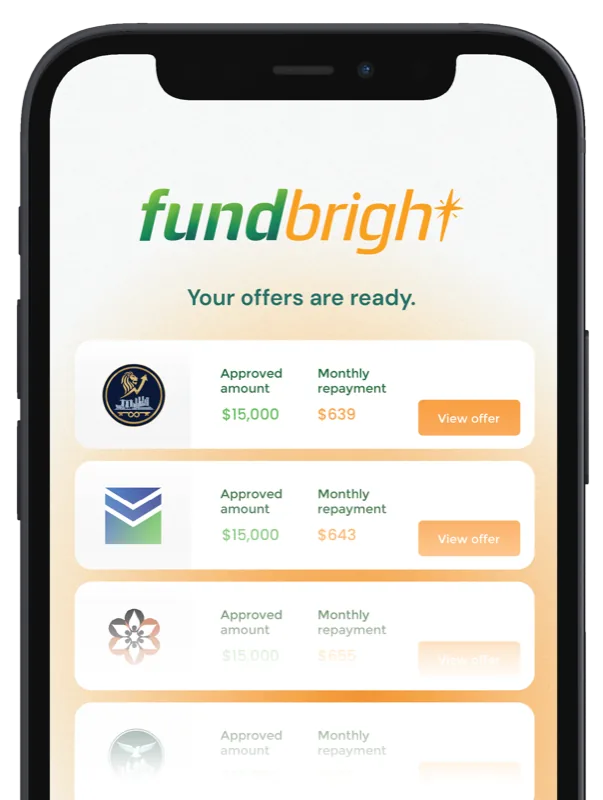
Ruling out CPF early stops you planning around savings CPF holds back, and the next step is to compare licensed offers through Personal Loan Comparison (Singapore), which lines up licensed offers on one soft enquiry; the single MLCB check is done once, in person, by the lender you choose after you pick its offer.
Best offer wins. No priority, no favourites. You stay in control.
Ready to find your best rate?
Compare Offers NowThese might also help
Ready when you are.Ready when you are.
checking will not affect your credit score