
Knowledge
One Word, Two Loan Worlds: Personal Loan (Singapore)
What is a personal loan in Singapore? Unsecured credit from a bank or a licensed moneylender, under different rules on rates, fees, limits and records.
Personal Loan (Singapore) is one name for two products: unsecured credit from a bank, and unsecured credit from a licensed moneylender, each under its own rules on rates, fees, borrowing limits and credit records. Knowing which one you are offered tells you whether a rate ceiling protects you, which credit bureau the lender reads and how much you borrow at most.
The Singapore Definition of a Personal Loan
A personal loan in Singapore is unsecured credit from either a bank or a licensed moneylender, repaid in fixed instalments, with the lender type deciding which caps, fees and credit bureau apply to you.
MoneySense's guide to the types of loans separates secured loans, where an asset such as a property is pledged to the lender as collateral, from unsecured loans, where nothing is pledged. The same guide separates term loans, which you repay by instalments over the loan period, from revolving credit, which you draw up to a credit limit. A personal loan sits in both unsecured and term-loan groups at once.
| Product | Secured? | Lender | Counts as a personal loan? | Reason |
|---|---|---|---|---|
| Bank personal loan | No | Bank | Yes | Unsecured term loan repaid in instalments |
| Licensed-moneylender loan (unsecured) | No | Licensed moneylender | Yes | Same shape, under the Moneylenders Act 2008 |
| Credit card balance | No | Bank or card issuer | No | Revolving credit drawn up to a limit, not a term loan |
| Renovation loan | No | Bank | No | Unsecured but tied to renovation work against a quotation |
| Car loan | Yes | Bank or finance company | No | The car secures the loan |
Licensed moneylenders also grant secured loans, which carry the same 4% p.m. interest cap and sit outside the aggregate loan limit.
How does a personal loan differ from a secured loan?
The main difference between a personal loan and a secured loan is that a secured loan pledges an asset, such as a property or a car, as collateral, while a personal loan pledges nothing. The lender therefore relies on your income and your credit record instead, and MoneySense notes that unsecured loans carry higher interest rates.
Why Bank Loans and Moneylender Loans Are Not the Same Thing
Bank personal loans and licensed-moneylender loans follow different rules on interest, fees, eligibility and credit records, so the same name covers two different products. "Personal loan" is one label on two different licences, and the licence decides whether a rate ceiling exists at all. Which of the two lenders you qualify for decides your real cost far more than the advertised rate does.
On the licensed side, the law caps the admin fee at 10% of the loan, alongside the interest cap, and it limits your unsecured borrowing across all licensed moneylenders to 6x your monthly income once your annual income reaches S$20,000. Bank loans fall outside those caps and outside that aggregate limit. In FundBright's experience as a comparison platform, licensed lenders "don't rely on CBS scores as a primary underwriting tool, and they extend credit to borrowers banks routinely decline".
Who regulates each lender
Licensed moneylenders hold a licence from the Registry of Moneylenders at the Ministry of Law under the Moneylenders Act 2008, while MAS regulates banks. As at 1 November 2026, 153 licensed moneylenders held that licence. Before you borrow, learn how to check a licensed moneylender, because the licence carries the caps on what the lender charges you.
How the interest caps differ
A licensed moneylender charges at most 4% p.m. in interest, while a bank sets its own rate with no cap from MAS. The Registry of Moneylenders FAQ for borrowers states that the 4% p.m. interest cap has applied since 1 October 2015, whatever your income and whether the loan is secured or unsecured. On the bank side, MAS told Parliament in its September 2022 reply on regulating interest rates and fees that it "does not dictate interest rates and fees charged by financial institutions (FIs)", so each bank prices its own loans.
Bank rates spread widely as a result, and on 19 October 2026 UOB displayed personal loan EIRs from 1.93% p.a. to 17.62% p.a., while OCBC showed a 12-month EIR of 26.39% p.a. for incomes of S$20,000 to S$29,999. At the licensed-moneylender ceiling, a 12-month loan with the full 10% admin fee carries an EIR of about 70% p.a. (APR as shown on FundBright: 58% p.a.).
Which credit bureau each lender reads
Banks read your Credit Bureau Singapore (CBS) record, which carries a credit score. Licensed moneylenders read a separate record, and the Ministry of Law's announcement of the Moneylenders Credit Bureau explains that they submit borrower information to the bureau and use your Moneylenders Credit Bureau (MLCB) report to assess you before granting a loan; section 66 of the Moneylenders Act 2008 now makes obtaining that report a duty before every loan. Your MLCB record holds no bank data. In FundBright's experience, licensed lenders "are more flexible with a borrower with a poorer credit score as long as they have a clean MLCB record and decent income history".
The Regulator Behind Each Regime
Banks answer to MAS, while licensed moneylenders answer to the Ministry of Law's Registry of Moneylenders under the Moneylenders Act 2008. The two regulators set different rules on interest, borrowing limits, credit records, identity checks and tenure.
Table: how bank rules and licensed-moneylender rules split Personal Loan (Singapore) into two products, verified 19 October 2026
| Rule | Bank personal loan | Licensed-moneylender loan | Source | Verified on |
|---|---|---|---|---|
| Interest cap | None set by MAS; each bank prices its own loans | 4% p.m. | MAS parliamentary replies; Registry of Moneylenders FAQ | 19 October 2026 |
| Borrowing limit | No further unsecured credit once interest-bearing unsecured debt across all banks and financial institutions exceeds 12x monthly income for three consecutive months; each bank sets its own loan limit | Unsecured loans across all licensed moneylenders capped at 6x monthly income from S$20,000 a year | MAS borrowing-limit explainer; Registry of Moneylenders FAQ | 19 October 2026 |
| Credit record read | CBS, plus income checks | MLCB, before every loan | MAS written reply, 8 April 2025; Ministry of Law | 19 October 2026 |
| Identity check | Online application, with Myinfo (Singpass) at DBS | In person at the lender's approved place of business before any loan | DBS; Registry of Moneylenders | 16 to 19 October 2026 |
| Tenure | 6 to 60 months (DBS), 1 to 5 years (UOB), 12 to 60 months (OCBC) | Set per loan by the lender; no legal maximum found | Bank product pages; Registry and Ministry of Law pages | 19 October 2026 |
The MAS explainer on the borrowing limit on unsecured credit applies the 12x rule to banks and other financial institutions, and MAS's April 2025 written reply on credit card debt confirms that they check your income and credit bureau records when you apply for a credit card or a credit limit increase. Licensed moneylenders follow their own aggregate limit instead.
Is a licensed moneylender a bank?
No, a licensed moneylender is not a bank; it holds a moneylending licence from the Registry of Moneylenders at the Ministry of Law under the Moneylenders Act 2008. The Registry's list of licensed moneylenders sets the identity rule for licensed moneylenders: "Licensed moneylenders are required to meet the borrower in person at the approved place of business ... to conduct physical face-to-face verification of his identity before granting any loan."
Key Features That Define a Personal Loan
Five features define a Singapore personal loan: no collateral, a fixed repayment term, an interest rate, permitted fees and an income-based borrowing limit. MoneySense's guide to the types of loans treats a loan with no pledged asset as unsecured, and the lender type sets the detail of each feature, so the same feature reads differently on a bank offer and on a licensed-moneylender offer.
Tenure
At the three banks checked on 19 October 2026, a personal loan runs for a fixed term of up to five years, while a licensed moneylender sets the term loan by loan. The DBS Personal Loan page offers 6, 12, 24, 36, 48 or 60 months, with only 6, 12 or 24 months for loans of S$3,000 or less and for non-citizens or non-PRs. UOB offers 1 to 5 years and OCBC 12 to 60 months. On the licensed side, the Registry of Moneylenders and Ministry of Law pages checked set no maximum tenure, and FundBright's personal loan calculator covers 3 to 36 months.
Fees you pay
A licensed moneylender charges an admin fee (the Act's upfront fee) of up to 10% of the loan, which comes off your payout at the start, while each bank sets its own processing fee. Under the Moneylenders Rules 2009, interest, late interest, the admin fee and late fees together stay within the principal. Unsecured, non-business loans disbursed on and after 15 September 2026 also give you a cooling-off period of three business days to cancel at reduced cost, as the Registry of Moneylenders FAQ sets out. Bank fees on 19 October 2026 vary by bank: DBS charges 1%, OCBC charges S$200 or 2%, whichever is higher, for incomes of S$30,000 and above, and UOB waives its fee.
How much you borrow at most
Your unsecured borrowing from licensed moneylenders stops at 6x your monthly income across all of them combined, once your annual income reaches S$20,000, with lower fixed amounts below that. Take a S$4,000 monthly salary: your unsecured licensed loans together top out at S$24,000. Banks set their own limits inside the MAS 12x rule; OCBC, for example, lends up to 6x monthly income for incomes of S$120,000 and above. Minimum incomes on 18 November 2026 differ too, with OCBC accepting citizens and PRs from S$20,000 a year and DBS and UOB from S$30,000.
How fast is a personal loan paid out?
FundBright targets same-day disbursement through licensed lenders, once you complete the in-person identity check at the lender's approved place of business. In FundBright's experience, bank decisions take up to a week or more, though DBS pays approved loans into your account through digibank, with late-night approvals credited the following day. A fast payout tells you nothing about the cost, and a short loan spreads the admin fee over fewer months, so read up on how the effective interest rate (EIR) works and check it on each offer before you choose on speed alone.
What People Use Personal Loans For
Singapore borrowers use personal loans for medical bills, renovation gaps, weddings, education, debt consolidation and short-term bridging.
Medical bills
A personal loan covers a medical bill your savings do not meet, though the admin fee shrinks what you receive. Take a S$10,000 licensed-moneylender loan for a S$10,000 bill: with the full 10% admin fee, S$9,000 reaches your account. On the bank side, the MAS release on the borrowing limit on unsecured credit excludes loans granted specifically for medical purposes from the 12x limit, while a general personal loan used for the bill still counts.
Renovation gaps
A personal loan covers the part of a renovation that a renovation loan leaves out. The DBS Renovation Loan covers renovation work only, against a signed itemised quotation, up to 6x monthly income or S$30,000, whichever is lower, so items such as furnishings fall to a personal loan.
Weddings
Weddings are one of the purposes that FundBright's borrowers name, and a personal loan spreads the cost into fixed instalments. Those instalments let you plan the repayment around a date you already know.
Education
Course fees are another purpose that FundBright's borrowers name, and a personal loan pays them up front. On the bank side, a loan granted specifically for education purposes sits outside the MAS 12x limit, while a general personal loan used for the fees still counts.
Debt consolidation
A personal loan for debt consolidation replaces several card or loan balances with one loan and one instalment. You then track one due date instead of several.
Short-term bridging
Bridge a short gap with a licensed loan for the part a bank product leaves uncovered. Take a bank balance transfer limit of S$5,000 against a S$10,000 need, and a licensed loan covers the remaining S$5,000, bearing in mind that any admin fee comes off the payout, so the cash you receive is less than the loan amount.
What This Means for Your Rate
The lender type you qualify for sets the range of rates you see. Take a S$1,000 loan over 12 months at the licensed-moneylender ceiling of 4% p.m. with a 10% admin fee: you pay S$106.55 a month, an EIR of about 70% p.a. and an APR as shown on FundBright of 58% p.a., and an offer below the ceiling costs less.
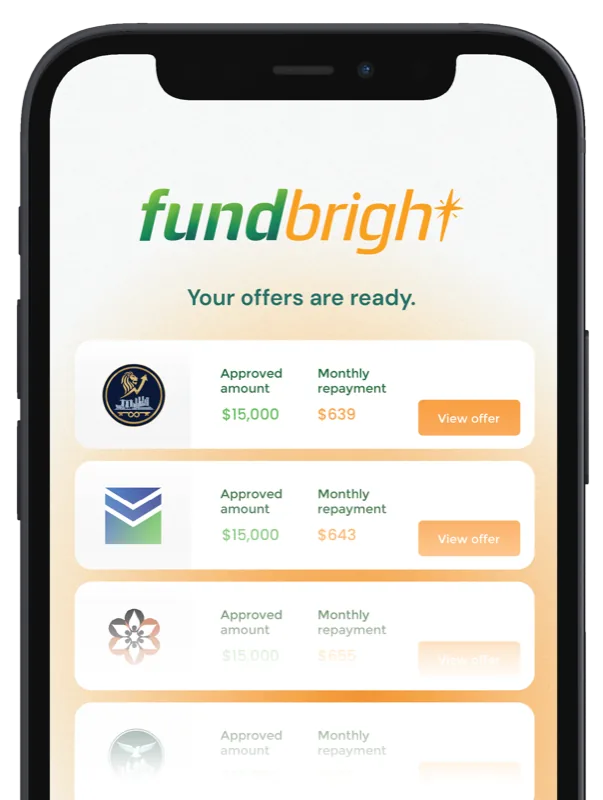
Knowing which lender type fits your profile shows which quotes are fair, and the next step is to compare licensed offers through Personal Loan Comparison (Singapore), which returns offers from licensed moneylenders on one soft enquiry, with the single MLCB check run in person by the lender you choose.
Best offer wins. No priority, no favourites. You stay in control.
Ready to find your best rate?
Compare Offers NowThese might also help
Ready when you are.Ready when you are.
checking will not affect your credit score