
Knowledge
The Letter Grade on Your Bank Credit Report: Credit Bureau Singapore (CBS)
CBS credit score Singapore: how Credit Bureau Singapore (CBS) grades you AA to HH, how long records stay, and how to check or correct your report.
Credit Bureau Singapore (CBS) keeps the record of your bank and card borrowing and turns it into a score and a letter grade. Your grade moves with how you repay, how much of your credit you use and how often you apply, and checking your own report leaves it unchanged.
What Your CBS Score Measures
Credit Bureau Singapore (CBS) turns your bank and card repayment record into a risk grade and, for grades AA to HH, a score between 1,000 and 2,000, and banks read that report when you apply for credit.
| Item | In your CBS record? | Who reports it | What the record shows | Effect on the score |
|---|---|---|---|---|
| Bank loans | Yes | Banks and finance companies | Balances and repayment status | Counts towards your score |
| Credit cards | Yes | Card issuers | Balances and late payments | Counts towards your score |
| New bank applications | Yes | The bank you apply to | A "New Application" enquiry | Counts as recent credit activity |
| Review and guarantor enquiries | Yes | A bank reviewing your account or your guarantee | A "Review" or "Guarantor" enquiry | No effect |
| Checking your own report | Yes | You | A self-enquiry | No effect |
Banks, finance companies and card issuers report to the bureau, and Credit Bureau Singapore's own report explanation and MoneySense both describe the score as a reading of that reported history.
Is a CBS score the same as an MLCB record?
No, a CBS score and an MLCB record are two different things. CBS scores your bank and card borrowing, while the Moneylenders Credit Bureau (MLCB) holds your licensed-moneylender loans, with no score in the Ministry of Law's description of its report, and every licensed lender checks it before granting a loan.
The AA to HH Grades and What They Mean
Your CBS report carries a letter grade and, for the eight scored grades, a four-digit score, and lenders read it next to your income and other factors, not on its own. Think of the grades as rungs on a ladder, with AA at the top and HH at the bottom of the scored range, and a lender sees which rung you stand on, then reads the report lines that put you there. Five of the thirteen CBS grades carry no score at all, so a thin or troubled file reads very differently from a low score.
The Credit Bureau Singapore sample consumer credit report with explanations sets the Bureau Score range at 1,000 to 2,000 for grades AA to HH, and states that the score is one of several factors a lender considers and makes no credit decision itself. Licensed-moneylender loans sit outside these grades, so check what your MLCB record shows before you compare licensed offers.
The eight scored grades and the five unscored grades
Table: the thirteen risk grades on a Credit Bureau Singapore (CBS) report.
| Grade | Score | What CBS says it means | What a lender sees | Source |
|---|---|---|---|---|
| AA | Top of the range, up to 2,000 | Lowest scored risk | The strongest scored file | CBS report explanation |
| BB to GG | Between the AA and HH bands | Risk rises band by band | A scored file in the middle bands | CBS report explanation |
| HH | Bottom of the scored range | Bottom of the scored range | A scored file at the bottom of the range | CBS report explanation |
| HX | No score | Public record (writ of summons or bankruptcy) | A legal record on file | CBS report explanation |
| HZ | No score | Currently 90+ days overdue or written off, with S$300 or more outstanding | A serious default | CBS report explanation |
| GX | No score | Enquiry record only | No credit file yet | CBS report explanation |
| BX | No score | Only inactive or specific account types | No active borrowing to score | CBS report explanation |
| CX | No score | Insufficient credit activity | Too little data to score | CBS report explanation |
What moves you between grades
Your grade moves whenever the credit data on your report changes. Late payments, rising balances and new applications push the score down, while on-time repayments rebuild the rolling 12-month account history that the report shows. An overdue balance appears on your report once it reaches S$200.
How clustered bank applications show up
Each new bank application lands on your report as an enquiry and stays there for 2 years, and Too Many Enquiries is one of the six factors CBS prints when it explains a score. Take an illustrative case: you apply to three banks in one week, your CBS score falls by 15 points, and the next bank prices you in a higher rate band. Those figures illustrate the effect and are neither a FundBright client outcome nor a CBS formula. Checking your own report is not a lender enquiry and leaves the score unchanged.
Where CBS Sits Among Singapore Credit Records
CBS is the bank-side credit record, built from what banks, finance companies and card issuers report, and the MLCB is the separate licensed-moneylender record. Banks, finance companies and credit card companies are the bureau's members, as the Association of Banks in Singapore media release of 21 March 2016 lists them. CBS is a credit bureau licensed by MAS. The MAS Licensed Credit Bureaus FAQ explains that MAS licenses and supervises credit bureaux to protect borrower data and consumers' interests.
| Bank product | Enquiry type recorded | Effect on the score | How long it shows | Source |
|---|---|---|---|---|
| New personal loan application | New Application | Counts towards Too Many Enquiries | 2 years | CBS report explanation |
| New credit card application | New Application | Counts towards Too Many Enquiries | 2 years | CBS report explanation |
| Standing as a guarantor | Guarantor | No effect | 2 years | CBS report explanation |
Since the 2023 amendments, licensed lenders are allowed to share specified borrower data with prescribed credit bureaux, as the Second Reading speech on the Moneylenders (Amendment) Bill of 22 November 2023 sets out.
Do licensed moneylenders check my CBS score?
Yes, some licensed moneylenders ask for your CBS report, with your consent, to get a fuller picture of how you use credit, and in FundBright's experience they do not rely on the CBS score as their main underwriting tool. The record every licensed lender checks before a loan is your MLCB record.
What Shapes Your CBS Grade
Your repayment record, how much of your credit you use, how many bank applications you make and how long you have held credit all shape your CBS grade. CBS prints up to six key contributing factors on each report, namely Immature Credit History, Credit Exposure, Delinquency Presence, Not Enough Clean History, Adverse Credit History and Too Many Enquiries, as the Credit Bureau Singapore report explanation sets out. The MoneySense guide to credit reports and creditworthiness lists the same drivers in plain words, from late payment and credit utilisation to the length of your history and your recent credit.
Repayment record
Late payments count against you as delinquency, and they stay visible in your monthly account status. A balance that is 90 or more days overdue, or written off with S$300 or more outstanding, moves your file out of the scored range and into the unscored HZ grade.
Credit use and card balances
Credit Exposure reflects how much you owe and how many credit facilities you hold. MoneySense names credit utilisation and the credit still available to you among the drivers of your score.
Bank applications in a short period
Several new bank applications in a short period weigh on your grade, because MoneySense links more loan applications with higher credit risk. Spacing your applications out gives the bureau fewer recent enquiries to count.
Length of credit history
A short credit history counts against you twice, through Immature Credit History and Not Enough Clean History, which CBS treats as separate factors. A longer clean record of on-time repayments counts in your favour.
How long does a missed payment stay on my CBS report?
A missed payment stays in your rolling 12-month account history, while a default stays for 3 years from the date it is marked settled, or indefinitely if it stays outstanding, partly paid or sold off.
Table: how long each record stays on a Credit Bureau Singapore (CBS) report.
| Record | What it covers | How long it shows | Counted from | Source |
|---|---|---|---|---|
| Account status | Monthly repayment status | Rolling 12 months | Each month | CBS report explanation |
| Closed account | Its last 12 months of status | 3 years | Not stated | CBS report explanation |
| Previous enquiries | New Application, Review and Guarantor | 2 years | The enquiry date | CBS report explanation |
| Default, settled | Settled in full or by negotiation | 3 years | The status date | CBS report explanation |
| Default, unsettled | Outstanding, partly paid or sold off | Indefinitely | Not applicable | CBS report explanation |
| Bankruptcy | Bankruptcy record | 5 years | Discharge | CBS report explanation |
| Writ of summons | A concluded writ | 3 years | Not stated | CBS report explanation |
The account-history, enquiry, default and bankruptcy periods also appear in the DBS explainer on understanding credit scores, the bank's own summary of the CBS rules.
When Your CBS Report Weighs Most
Your CBS report weighs most when you apply to a bank, when an application falls just short, and before you apply, when you check it yourself.
Applying for a bank personal loan
A bank reads your CBS score together with your income and other factors when you apply for a personal loan. CBS states that the score itself makes no credit decision, so the bank weighs it with the rest of your application.
Falling just short of a bank approval
A lower grade or a thin file narrows your bank options, even when your income is steady. A bank that turns you down for one of these reasons has measured you against its own criteria, so read about borrowers just short of bank approval before you look at other lenders.
Checking your own report first
Check your own report before you apply, because a self-enquiry leaves your score unchanged, as the MoneySense guide to credit reports confirms. The Association of Banks in Singapore announced in 2016 that anyone who applies for credit with a bureau member receives a free credit report, whether approved or rejected, claimed within 30 calendar days of the letter. The Credit Bureau Singapore credit report page, checked on 18 November 2026, sells your report online through Singpass for S$8 before GST, or in person at the CBS office at 2 Shenton Way, #20-02, SGX Centre 1, if you have no Singpass.
If your report shows a mistake
Write to the bureau, or approach the bank that reported the entry, when your report shows a mistake. The bureau forwards your dispute to the member that supplied the data and flags the entry as disputed. Under MAS Notice CBN01 to licensed credit bureaux and approved members, the bureau completes its investigation, corrects the entry and sends the corrected data within 10 business days of receiving your request, or within 20 business days at most when it extends the investigation. The bureau tells you the outcome and sends the revised report to every member that enquired on you in the past 12 months. The MAS Licensed Credit Bureaus FAQ states that MAS has no power to direct a bureau to change your score, so the bureau and the reporting bank are the two places to raise an error.
Will applying or comparing on FundBright affect my credit profile?
No. FundBright runs one soft enquiry at the comparison stage. A soft enquiry does not affect your credit profile. A hard pull happens only when you provide consent, during your in-person appointment at the lender's approved place of business.
What to Do Before Your Next Application
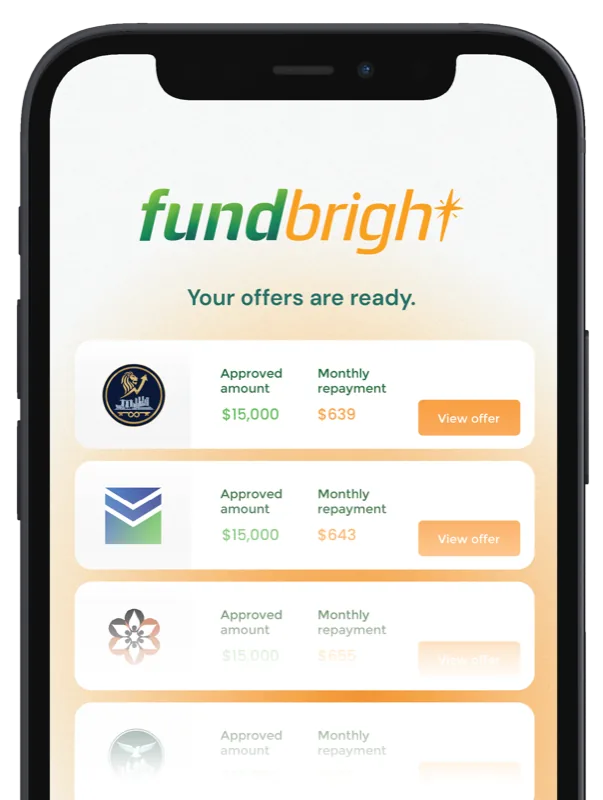
Before your next application, compare licensed offers on one soft enquiry, which adds no bank enquiry to your CBS report. FundBright's soft enquiry is an internal eligibility step, not a credit-bureau pull, and the single MLCB check happens once, in person, at the lender you choose after you accept its offer. Keeping bank enquiries off your report avoids adding to the Too Many Enquiries factor, and the next step is to compare licensed offers through Personal Loan Comparison (Singapore), which returns offers from licensed moneylenders without a bank enquiry.
Best offer wins. No priority, no favourites. You stay in control.
Ready to find your best rate?
Compare Offers NowThese might also help
Ready when you are.Ready when you are.
checking will not affect your credit score