
Solutions
A Personal Loan for Foreign Workers in Singapore: Your Income and Work Pass Determine the Rate, Not Your Nationality
Personal loan for foreign workers in Singapore: licensed moneylenders lend to EP and S Pass holders on the Moneylenders Act income test. One soft enquiry.
EP and S Pass holders pass the Moneylenders Act income test. Licensed lenders price the MLCB record; banks add a residency screen the Act does not require.
Who Qualifies as a Foreign-Worker Borrower
Licensed moneylenders lend to Employment Pass and S Pass holders who meet the income test under the Moneylenders Act, even where banks apply harder citizenship and tenure requirements.
The Moneylenders Act sets the eligibility floor by income, not by citizenship or work-pass type. An EP holder at S$5,600 per month and an S Pass holder at S$3,300 per month both sit above the income threshold the Act requires for the standard 6x aggregate loan limit. The bank's residency screen and the 12-month tenure requirement are bank policy, not law.
These figures reflect MOM's Employment Pass qualifying salary of S$5,600 per month (effective 1 January 2025) and S Pass qualifying salary of S$3,300 per month (effective 1 September 2025), and the Moneylenders Act Cap. 188 6x aggregate loan cap for borrowers earning S$20,000 or more annually.
Can a foreigner get a personal loan in Singapore?
A foreigner holding an Employment Pass or S Pass gets a personal loan from a licensed moneylender in Singapore when the income test under the Moneylenders Act is met. Banks apply additional residency and tenure requirements that licensed moneylenders do not. The Moneylenders Act sets the floor; the bank sets its own, higher bar.
Why Banks Reject and Licensed Lenders Accept
Banks reject many pass holders on tenure and citizenship thresholds; licensed moneylenders assess the MLCB record and the income test that the Moneylenders Act explicitly permits, a different eligibility system and not a higher-risk lender.
A work-pass holder is invisible to most bank credit models but fully visible to the MLCB; licensed lenders price the MLCB record, not the passport.
The cut-off many foreign workers hit in Singapore is a bank policy, not a legal bar. Licensed moneylenders operate under an explicit statutory permission to lend to pass holders who meet the income test, because the bank's screen and the Act's floor are two separate systems. Borrowers who fail the bank's screen have not been told they cannot borrow; they have been told that bank's product is unavailable to them.
The Pass-Type Rules Banks Apply
Banks in Singapore typically require borrowers to be Singapore Citizens or PRs, or EP holders with at least 12 months of Singapore work history and a minimum annual income ranging from S$42,000 to S$90,000 depending on the bank.
These thresholds are internal bank policy, not statutory requirements. An EP holder who joined Singapore six months ago at S$6,000 per month sits above the licensed-lender income floor and below most banks' tenure cut-off. The licensed-moneylender route is not a fallback for weak borrowers; it is the statutory route for borrowers who pass the Act's income test but fail the bank's non-statutory residency requirement.
The bank's internal scorecard does not appear in the Moneylenders Act or in any MinLaw Registrar's Direction. Banks invented their own additional screens on top of the statutory minimum.
What the Moneylenders Act Actually Says About Foreigners
The Moneylenders Act sets eligibility by income, not by citizenship or work-pass type; the same 6x aggregate loan limit and permitted-fees schedule apply to pass holders as to citizens.
For borrowers earning above S$20,000 per year, the Act sets a maximum aggregate outstanding loan limit of 6x the borrower's monthly income across all licensed moneylenders simultaneously. This cap applies equally to Singapore Citizens, PRs, EP holders, and S Pass holders. The Act imposes no minimum tenure requirement, no citizenship requirement, and no nationality screen.
The aggregate cap matters: a pass holder with S$10,000 outstanding across multiple lenders cannot borrow more than the remainder of 6x their monthly income, regardless of which lender they approach. FundBright's soft enquiry surfaces the current aggregate position so both the borrower and the lender see it before any offer is made.
This 6x aggregate cap for higher-income borrowers, extended to foreigners residing in Singapore including EP and S Pass holders, was confirmed by MinLaw and MOM in the October 2018 extension of borrower protections under the Moneylenders Act Cap. 188.
Why the Rate Gap Exists for This Segment
Lenders who price at the 4% p.m. ceiling charge every pass holder the maximum regardless of credit history; lenders who compete below the ceiling price the MLCB record, and FundBright's inverse commission model creates the incentive for them to do so.
A licensed moneylender charging 4% p.m. earns the same on a pass holder with a clean MLCB record as on a borrower with several outstanding loans. There is no pricing incentive to differentiate. FundBright's commission structure works differently: lenders on the network who offer lower rates pay a lower commission, so they compete on rate for borrowers who compare. A pass holder with a clean MLCB record comparing through FundBright accesses that competition. A pass holder approaching one lender directly does not.
The rate gap between the ceiling and a competed offer represents a real cash difference. On a S$20,000 loan over 12 months, the difference between 4% p.m. and a competed rate closer to 2.5% p.m. changes the total interest cost materially. All figures are illustrative; actual rates depend on the lender's assessment of the submitted profile.
Why do banks reject EP holders for personal loans?
Banks apply citizenship and residency screens that are their own policies, not statutory requirements. An EP holder with less than 12 months of Singapore work history typically falls below most banks' internal cut-offs, even where income is above S$5,600 per month. The Moneylenders Act has no equivalent tenure requirement for licensed moneylenders. The bank's screen is not the law.
The Income and Pass-Type Rules
The income and pass-type rules for licensed moneylenders are set by the Moneylenders Act: the same 6x aggregate loan limit and permitted-fees schedule apply to pass holders as to citizens.
The Act permits four categories of fees and no others: interest at up to 4% per month, an upfront admin fee at up to 10% of the principal, a late interest charge at up to 4% per month on overdue amounts, and a late fee of up to S$60 per month. The Act permits no other charges.
Foreigners residing in Singapore, including EP and S Pass holders, are protected by the same tiered aggregate loan caps as Singapore Citizens and Permanent Residents: borrowers earning under S$10,000 a year may borrow up to S$500 in total across all licensed moneylenders, those earning S$10,000 to under S$20,000 a year up to S$3,000, and those earning S$20,000 or more, which covers virtually every EP and S Pass holder at current MOM qualifying salaries, the standard 6x monthly income cap. Licensed moneylenders must also retrieve a borrower's MLCB credit report before granting any loan, regardless of nationality.
What MLCB Tracks for Non-Citizens
The MLCB records a pass holder's licensed-moneylender loans with no score; the single hard pull happens in person when the chosen lender verifies identity at its approved place of business under the Moneylenders Act.
FundBright is a comparison platform, not a licensed moneylender. It forwards the borrower's profile to the signed moneylenders in its network; the lenders make offers from the submitted profile. FundBright does not pull the MLCB record at the comparison stage.
Two credit systems operate in parallel in Singapore. Banks use the Credit Bureau Singapore (CBS), which produces a credit score; clustered bank applications lower that score because each bank enquiry registers as a separate event. Licensed moneylenders use the Moneylenders Credit Bureau (MLCB). It records each loan disbursed and its outstanding balance. There is no MLCB score. A comparison on FundBright touches neither bureau at the enquiry stage; lenders assess the submitted profile against their own criteria, and the lender the borrower selects accesses the MLCB record once, in person.
The Moneylenders Act requires the following: "A licensed moneylender must verify the borrower's identity by meeting the borrower in person at the licensed moneylender's approved place of business before granting any loan. A loan transaction performed fully online, and at locations other than the approved places of business, is disallowed."
The result: one soft enquiry through FundBright; if you apply directly, each lender may perform its own MLCB check before making a loan offer.
Will applying or comparing on FundBright affect my credit profile?
No. FundBright runs one soft enquiry at the comparison stage. A soft enquiry does not affect your credit profile. A hard pull happens only when you provide consent, during your in-person appointment at the lender's approved place of business.
What happens to my personal loan if my EP is not renewed?
If an EP is not renewed, the loan agreement with the licensed moneylender remains in force. The borrower is still liable for outstanding amounts under the terms of the Moneylenders Act. The aggregate loan limit does not change on EP cancellation. Borrowers in this situation communicate directly with their lender.
Compare Options for Pass Holders
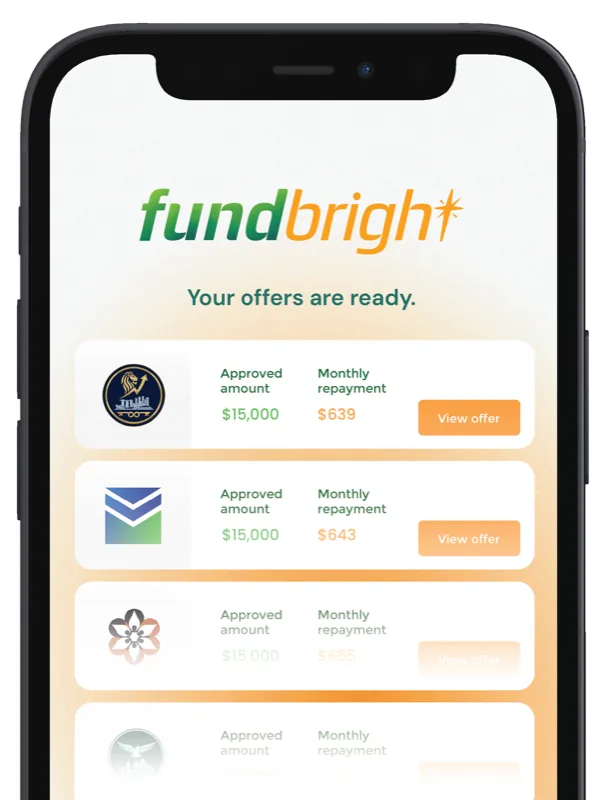
Comparing licensed-moneylender offers surfaces quotes pass holders rarely see from banks - on one soft enquiry.
A pass holder comparing on FundBright submits one profile; the signed moneylenders in the network return offers priced on the MLCB record and the income test, not citizenship. The lender with the best rate for the submitted profile wins the match. Best offer wins. No priority, no favourites. You stay in control.
Compare licensed-moneylender offers: Personal Loan Comparison Singapore
Ready to find your best rate?
Compare Personal Loan OffersThese might also help
Ready when you are.Ready when you are.
checking will not affect your credit score