
Solutions
Personal Loan for Students Singapore: When Banks Say No on Employment Type
Personal loan for students Singapore: working students earning S$2,500+ qualify through FundBright's partner-lender screen. One soft enquiry, same-day offers.
A working student earning at least S$2,500 per month can qualify for a personal loan from a licensed moneylender of up to 6x their monthly income, even when a bank declines on employment type.
Who Qualifies: Working Students, Part-Time Students, Mature Learners
Working students, part-time students, and mature learners who earn at least S$2,500 per month qualify for a personal loan through licensed moneylenders, regardless of whether a bank has declined on employment type.
| Learner Type | Monthly Income | Bank Personal Loan | Licensed Moneylender | Typical Purpose |
|---|---|---|---|---|
| Full-time student, no income | Nil | Not eligible | Not eligible | FundBright income screen not met |
| Working student (part-time employed) | S$2,500+ | Often declined (employment type) | FundBright's income screen met | Living costs, equipment, private course fees |
| Part-time student (full-time employed) | S$2,500+ | Possible (depends on DTI (debt-to-income ratio) and employment type) | FundBright's income screen met | Upskilling courses, CPD fees, skills gap |
| Mature learner (career break) | S$2,500+ from part-time or freelance | Often declined (variable income) | Eligible: documented income at or above floor | Reskilling, private certifications, ICDL |
| Recent graduate on probation | S$2,500+ | Often declined (probation period) | FundBright's income screen met | Bridging costs during onboarding period |
Your borrowing limit is set by the Moneylenders Act's income-based aggregate cap: up to 6x monthly income once annual income reaches S$20,000 (lower caps of S$500 to S$3,000 apply below that). FundBright's partner lenders screen applicants at S$2,500 per month documented income. Documentation requirements vary by lender but typically include recent payslips or CPF contribution history. The income category, whether part-time, freelance, or salaried, does not change eligibility at licensed moneylenders; only the documented income amount matters.
Why Banks Say No and Licensed Moneylenders Apply a Different Test
Banks reject many students on employment-type scorecards, not because the income is too low, but because the income category does not fit the salaried-employee template the scorecard was built for.
A bank assesses income against a scorecard calibrated for salaried employees; a licensed moneylender assesses income against the floor the Moneylenders Act itself sets, which is separate from FundBright's own S$2,500 partner-lender screen. A working student with documented income at or above S$2,500 per month can qualify through FundBright's partner-lender screen even after the bank's scorecard rejects on employment type. Working, part-time, and mature students can qualify the same way, provided documented income and lender assessment both pass.
What the Bank's Scorecard Checks
A bank's personal loan scorecard looks at four factors: income level, income stability (permanent vs contract vs variable), employment status (probation, part-time, freelance), and total debt service ratio relative to an approved minimum income threshold. Most Singapore banks set a minimum income of S$20,000 per year (approximately S$1,667 per month), but many apply a higher effective floor for non-standard employment types. A working student drawing S$2,800 per month from part-time work at two employers may pass the income level check and fail on income stability. A recent graduate on three months' probation may pass both and fail on employment status. The scorecard does not weight the income floor and employment type checks equally across all banks; the outcome depends on the scorecard architecture the bank uses for unsecured lending.
What the Moneylenders Act Income Floor Checks
The Moneylenders Act sets income-based borrowing caps: up to 6x monthly income once annual income reaches S$20,000, with lower caps of S$500 to S$3,000 for incomes below that threshold. A borrower who meets this floor and documents their income qualifies for a personal loan of up to six times their monthly income. A working student earning S$2,600 per month has a borrowing capacity of up to S$15,600 across all outstanding licensed-moneylender loans combined. The aggregate limit applies across all loans, not per loan. Income documentation acceptable to licensed moneylenders includes payslips, CPF statements, employer letters, and bank statements showing regular credit entries for freelance or gig income.
How the Income Test Applies to Part-Time and Variable Pay
For part-time workers, FundBright's income screen applies to average monthly income over the three to six months prior to the application. A student who earns S$1,200 from one employer and S$1,500 from another demonstrates S$2,700 per month in documented income and clears the floor. For freelance and gig income, the lender reviews bank statements to establish a consistent monthly average. Variable income from gig work accepted by licensed moneylenders: the documentation standard is a demonstrated average, not a single pay stub. The bank's scorecard penalises income variability; the Moneylenders Act income floor does not.
Can a student get a personal loan from a licensed moneylender in Singapore?
A working, part-time, or mature student with documented income at or above S$2,500 per month can qualify for a personal loan from a licensed moneylender through FundBright's partner-lender screen. FundBright's partner lenders screen applicants at S$2,500 per month documented income; the Moneylenders Act does not disqualify on employment category. Banks assess employment type in addition to income level, and many students fail on employment type even when income exceeds the bank's stated floor. Licensed moneylenders assess documented income along with their own risk and repayment criteria, in addition to the legal income and borrowing cap requirements. A qualifying student borrows up to six times their monthly income across all outstanding licensed-moneylender loans.
Study Loan vs Personal Loan: What Each Covers
HESL covers tuition at approved institutions, plus a means-tested living allowance for lower-income households; a personal loan covers the costs HESL doesn't reach: the living-cost gap beyond that allowance, equipment, transport, and private course fees.
| Cost Category | HESL | Other Schemes (CPF-Education, Bursaries) | Personal Loan: Licensed Moneylender | Notes |
|---|---|---|---|---|
| Tuition fees at MOE-funded institutions | Yes: up to full fees | Yes (CPF-Education: CPF OA balance) | Yes | HESL preferred; personal loan fills shortfall if HESL is exhausted |
| Private school or overseas tuition | No | No | Yes | Licensed moneylender personal loan is the primary option |
| Living expenses (accommodation, food) | Means-tested (up to S$4,100/yr) | No (bursaries cover fees, not living) | Yes | Finance the living-cost gap beyond HESL's allowance; not daily variable spending |
| Laptop and course equipment | No | No | Yes | One-time cost; suitable for personal loan |
| Private certification or CPD fees | No | No | Yes | ICDL, AWS, PMI: not covered by study loans |
MinLaw Registrar's Directions:
A licensed moneylender must verify the borrower's identity by meeting the borrower in person at the licensed moneylender's approved place of business before granting any loan. A loan transaction performed fully online, and at locations other than the approved places of business, is disallowed.
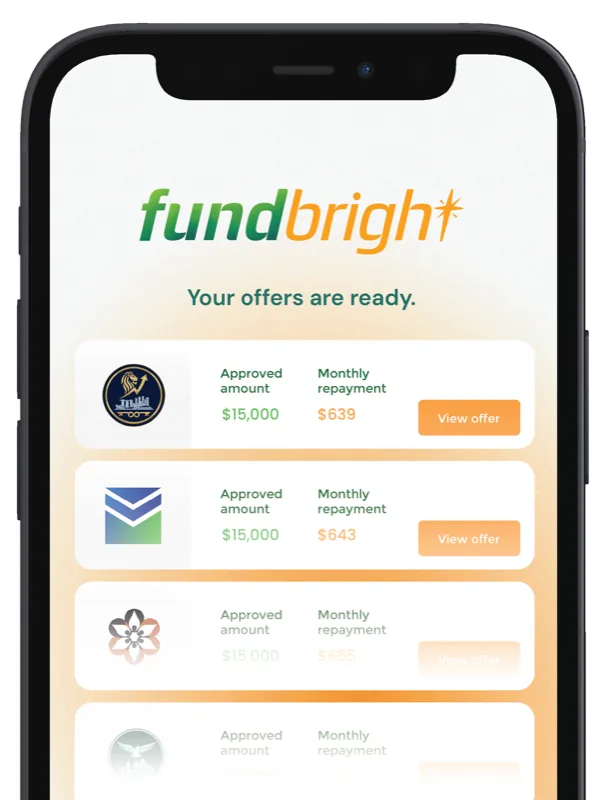
FundBright sends the borrower's profile to signed licensed moneylenders in the network. The lenders return actual offers, with no credit pull at the comparison stage. The borrower selects an offer and completes the mandatory in-person identity check once, at the chosen lender's approved place of business.
Will applying or comparing on FundBright affect my credit profile?
No. FundBright runs one soft enquiry at the comparison stage. A soft enquiry does not affect your credit profile. A hard pull happens only when you provide consent, during your in-person appointment at the lender's approved place of business.
Best offer wins. No priority, no favourites. You stay in control.
Calculating Your Study Shortfall and Monthly Repayment
Calculate the shortfall as total study costs minus HESL coverage and available income, then size the personal loan to keep monthly repayments within what part-time or variable income supports.
| Budget Item | Estimated Annual Cost | HESL Coverage | Gap to Finance | Indicative Monthly Repayment (12m) |
|---|---|---|---|---|
| Tuition: polytechnic or ITE (after CPF-Education) | S$1,500--4,000 | HESL covers remainder after CPF | S$0--1,000 shortfall if loan exhausted | ~S$0--97/month |
| Private certification or diploma fees | S$3,000--8,000 | No coverage | Full amount | ~S$292--780/month |
| Laptop and equipment | S$1,000--2,500 | No coverage | Full amount | ~S$97--244/month |
| Living costs (accommodation, food, transport), monthly | S$800--1,500/month | No coverage | Finance fixed portion only | ~S$200--400/month (fixed costs only) |
| Emergency buffer (10% of annual budget) | S$500--1,000 | No coverage | Optional | ~S$49--97/month |
A borrower earning S$2,500 per month has a maximum outstanding licensed-moneylender loan balance of S$15,000. A borrower earning S$4,000 per month has S$24,000. The 6x aggregate limit applies across all outstanding licensed-moneylender loans. Before borrowing, confirm the gap between total study costs and available funding (bursaries, CPF-Education, HESL, savings). Finance the one-off, fixed costs, equipment and certification fees, not recurring living expenses.
Compare Personal Loan Options for Students
A personal loan comparison returns actual offers from signed moneylenders for working students who clear FundBright's income screen. One soft enquiry; no credit impact at the comparison stage.
Ready to find your best rate?
Compare Personal Loan OptionsThese might also help
Ready when you are.Ready when you are.
checking will not affect your credit score