
Solutions
Same Lender, Lower EIR: How Your Submission Channel Determines the Rate
How to lower your personal loan EIR in Singapore: the lever is the submission channel, not negotiating the rate. Compare through one soft enquiry.
The EIR on your personal loan is set by the submission channel before the lender ever opens your file. Borrowers who compare through a platform structured on inverse commission receive offers that compete below the 4% p.m. ceiling, not by renegotiating with any individual lender, but because the channel's fee structure gives lenders a financial reason to price lower.
What Is EIR, and Why Does the Advertised Rate Miss It?
The effective interest rate (EIR) is the true annual cost of a personal loan once the monthly flat rate, the admin fee, and the reducing-balance repayment schedule are combined into a single annualised figure. Licensed moneylenders in Singapore quote monthly flat rates, which understate the real annual cost by a factor that grows with loan tenure and admin-fee size.
What does effective interest rate mean on a personal loan?
EIR on a licensed-moneylender personal loan represents the annualised cost of borrowing: interest charged on the original principal each month, plus the capped 10% admin fee, plus the effect of repaying against a reducing balance. On a 12-month loan at 4% flat per month with a 10% admin fee, the EIR rises to approximately 97% per annum. On a loan at 2.5% flat per month with a 5% admin fee, the EIR falls to approximately 49% per annum. The 48-percentage-point spread between those two figures traces back to the submission channel's commission structure.
Workflow Snapshot: What EIR Actually Measures
| Cost Component | What It Represents | In Advertised Monthly Rate? | In EIR? |
|---|---|---|---|
| Monthly flat rate (up to 4% p.m. ceiling) | Interest charged on the original principal each month | Yes | Yes |
| Admin fee (up to 10% of principal, one-time) | Capped one-off fee added to the cost of the loan | No | Yes |
| Reducing-balance repayment effect | The gap created because interest is flat on the original principal while the balance amortises down | No | Yes |
The Channel Thesis: Why the Rate Quote Starts Before the Lender Sees You
The rate gap between what a lender advertises and what a borrower actually receives traces back to the submission channel's commission structure, not the lender's credit assessment of the borrower.
The lender that prices your loan does not change; the channel that submits your file does, and the channel sets the commission baked into your rate.
When the channel earns a fixed commission regardless of the rate the lender offers, the lender has no financial incentive to price below the 4% p.m. ceiling. Inverting that commission structure, so the channel earns less when the rate is lower, converts the platform's economic interest from neutral to aligned with the borrower's. Singapore's Moneylenders Act (Cap. 188, Registered Moneylenders Rules) caps monthly interest at 4% p.m. and admin fees at 10% of the principal. The cap sets the ceiling. The commission structure determines where within that permissible range lenders actually price their offers.
What the Flat-Commission Model Does to the Rate You See
Under a flat-commission model, the introducing platform earns the same fee whether the lender offers 2.5% p.m. or 4% p.m. flat. The lender retains more margin at 4% p.m. and the platform's income is unaffected either way, so neither party bears a financial cost from pricing at the ceiling.
Borrowers comparing through flat-commission platforms receive offers clustered at or near the 4% p.m. ceiling regardless of their credit profile. The 10% admin fee on top of the 4% flat monthly rate produces an EIR of approximately 97% per annum on a 12-month loan (MinLaw, Moneylenders Act Cap. 188, Registered Moneylenders Rules). That is the all-in cost before any late fees apply. The advertised monthly rate of "4%" describes only the flat interest component; it does not reflect the total cost at which the loan disburses.
How Inverse Commission Shifts the Lender's Pricing Incentive
Under an inverse-commission model, the platform earns a lower fee every time a lender prices the loan at a higher rate. The platform's revenue rises when lenders price lower, so lenders that compete on rate generate more volume and the platform's economics improve together with the borrower's.
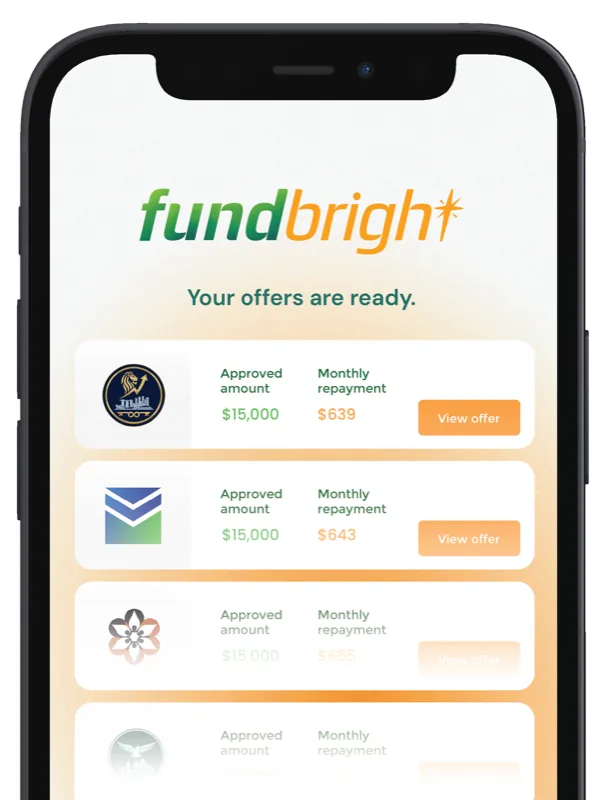
FundBright's commission schedule operates on this inverse structure: licensed moneylenders in the FundBright network pay a lower commission when they offer borrowers a lower rate. On a 12-month loan of S$15,000, illustrative offers from lenders in the network run at approximately 2.5% p.m. flat plus a 5% admin fee, compared with the 4% p.m. plus 10% admin ceiling (internal projection; individual terms depend on the borrower's income, credit profile, and lender assessment). That rate differential produces an illustrative saving in total cost of borrowing (interest plus admin fee, on a reducing-balance repayment schedule) of approximately S$2,380 over the loan term on a S$15,000 12-month loan (internal projection; illustrative example).
FundBright captures the final disbursed loan terms from both the lender and the borrower after the in-person appointment. This closed-loop attribution is the enforcement mechanism: the inverse-commission schedule applies to the rate the borrower actually receives, not the rate quoted at offer stage.
The One Credit Pull That Changes How Lenders Compete
The Moneylenders Act (s30N) requires a licensed moneylender to pull an MLCB credit report before granting any loan, and the MinLaw Registrar's Directions require in-person identity verification at the lender's approved place of business before disbursement.
The borrower therefore faces exactly one mandatory hard credit pull at the point of selecting and visiting a lender, not one pull per lender approached. The MLCB (Moneylenders Credit Bureau) records credit data specific to the licensed-moneylender lending system. It does not produce a score in the way that the Credit Bureau Singapore (CBS) does for bank-side credit, and an MLCB enquiry does not feed the CBS scoring model.
When a borrower self-shops by visiting multiple lenders directly, each lender may perform its own MLCB check if the application proceeds toward approval. When a borrower submits through FundBright, lenders review the submitted profile and return offers; the MLCB pull happens once, in person, at the lender the borrower selects. This confines the borrower's enquiry record to one lender rather than accumulating one per door visited.
Step 1: Pull Your CBS File Before You Apply
Your Credit Bureau Singapore (CBS) file determines whether bank-side borrowing options remain open to you while you compare licensed-moneylender offers, and reviewing it first prevents clustered enquiry damage before the comparison begins.
CBS records every hard enquiry from banks and credit-issuing institutions. Multiple bank enquiries clustered within a short period lower the CBS score. A borrower who applied to three banks over two months before moving to a licensed-moneylender comparison arrived with a CBS score approximately 15 points below its starting level (illustrative case; individual outcomes depend on CBS scoring parameters, timing, and lender policy).
Pull your own CBS file via SingPass before starting any comparison. A personal credit report accessed directly by the borrower is a soft enquiry and does not affect the CBS score. The report is available from the Singapore Credit Bureau (creditbureau.com.sg) and reflects any lender enquiry within 24 hours of it being recorded.
The guide that validates Credit Bureau Singapore (CBS) Score enquiry mechanics and their 24-month visibility window covers how clustered bank enquiries register against the score used in bank credit decisions.
Does checking my own CBS score affect my credit rating?
No. A borrower checking their own CBS file is a soft enquiry and does not affect the CBS score. Only hard enquiries, initiated by a bank or credit issuer when a formal application is submitted, appear as enquiries that other lenders see. Personal credit report checks by the borrower do not appear in the enquiry section of the CBS report that is visible to subsequent lenders.
Step 2: Identify the EIR Floor Before You Compare
The EIR floor is the lowest all-in annual rate a lender realistically offers a borrower with a given profile, and calculating it before comparing confirms whether the comparison is worth running.
Calculate the EIR floor from three inputs: the flat monthly rate, the admin fee as a percentage of principal, and the loan tenure in months. On a 12-month loan at rate r% flat with an admin fee of a%, the all-in monthly cost approximation is: [(r x 12) + a] / 12, applied to the amortising outstanding balance. FundBright's quote form applies the MinLaw-compliant EIR formula automatically across the submitted profile, eliminating the manual calculation step.
The useful diagnostic is the gap between the ceiling EIR (approximately 97% p.a. at 4% p.m. flat plus 10% admin on a 12-month term) and the floor offer the lender network returns for the borrower's profile. A gap of more than 10 percentage points represents a meaningful saving on a S$10,000-plus loan over the full tenure.
The page that categorises Effective Interest Rate (EIR) within the MinLaw permitted-fees structure applies the formula to each cost component and shows what the loan agreement must disclose before signing.
What EIR is typical for a personal loan from a licensed moneylender in Singapore?
The maximum EIR on a 12-month licensed-moneylender personal loan in Singapore is approximately 97% per annum at the 4% p.m. flat interest ceiling plus the 10% admin fee cap (MinLaw, Moneylenders Act Cap. 188, Registered Moneylenders Rules). The practical range for borrowers with verifiable income at or above S$2,500 per month narrows as lenders price competitively for profiles that demonstrate repayment capacity. Through an inverse-commission channel, illustrative offers for eligible profiles run at EIRs approximately 25--48 percentage points below the ceiling (internal projection; individual terms depend on lender decision and borrower profile).
EIR Validation Checklist
| Step | What to Confirm | Where to Get It |
|---|---|---|
| 1. Flat monthly rate | The lender's quoted monthly interest rate | Lender's offer / FundBright quote |
| 2. Admin fee | The one-time admin fee as a % of principal (capped at 10%) | Lender's offer / FundBright quote |
| 3. Loan tenure | Number of months over which the loan is repaid | Lender's offer / FundBright quote |
| 4. Ceiling EIR reference | Approximately 97% p.a. at the 4% p.m. + 10% admin ceiling on a 12-month term | Reference figure, not your actual offer |
| 5. Gap vs ceiling | Difference between your offered EIR and the ceiling EIR; a gap above 10 percentage points is a meaningful saving on a S$10,000-plus loan | FundBright comparison result |
Step 3: Submit Once, Through a Channel That Counts as One Soft Enquiry
FundBright is a comparison platform, not a licensed moneylender. It forwards a borrower's submitted profile to the licensed moneylenders in its network; the lenders make offers on that profile with no credit pull at the comparison or offer stage.
The single mandatory credit pull under the Moneylenders Act (s30N) occurs when the borrower selects a lender and attends in person at the lender's approved place of business. The MinLaw Registrar's Directions state: a licensed moneylender must verify the borrower's identity by meeting the borrower in person at the licensed moneylender's approved place of business before granting any loan. A loan transaction performed fully online, and at locations other than the approved places of business, is disallowed.
The result: the borrower's mandatory hard MLCB pull occurs exactly once, at the lender of their choice. When self-shopping by visiting multiple lenders directly, the borrower triggers a separate MLCB pull at each door, each of which becomes visible to the next lender in the sequence.
Will applying or comparing on FundBright affect my credit profile?
No. FundBright runs one soft enquiry at the comparison stage. A soft enquiry does not affect your credit profile. A hard pull happens only when you provide consent, during your in-person appointment at the lender's approved place of business.
Step 4: Choose a Channel Whose Commission Falls When Your Rate Falls
The single actionable lever that lowers personal loan EIR is selecting a submission channel whose commission falls when the lender offers a higher rate, making the channel's economic interest structurally identical to the borrower's.
On a flat-commission platform, the lender holds the rate at or near the ceiling because no financial signal from the platform rewards lower pricing. On an inverse-commission platform, lenders that price below the ceiling win more business routed to them; the platform's revenue improves as rates fall.
FundBright's inverse-commission schedule gives lenders a direct pricing incentive below the 4% p.m. ceiling. FundBright captures the final disbursed loan terms from both the lender and the borrower after the in-person handover, so the inverse-commission schedule applies to the rate the borrower actually received, not just the rate quoted at offer stage. FundBright targets a disbursement rate of 90% across submitted profiles, prioritising confirmed loan completions over the volume of offers generated (internal target; illustrative projection).
Best offer wins. No priority, no favourites. You stay in control.
The page that validates Inverse-Commission Loan Comparison incentive mechanics shows how the commission reversal distributes pricing pressure across the licensed-moneylender network.
Step 5: Verify the Final Disbursed Terms Against the Offer
The offer a lender presents at the in-person session is the last point at which the borrower reviews every term before signing, and the disbursed terms are the only terms that carry legal weight once the loan agreement is executed.
At the in-person session, the lender presents the loan agreement before disbursement. Verify each of the five critical terms against the terms in the offer received through FundBright. If any figure diverges materially, the borrower has the right to decline at this stage without penalty. FundBright's closed-loop attribution captures the final disbursed terms from both the lender and the borrower after the handover, which is the mechanism that allows the inverse-commission schedule to be enforced against the actual rate received.
Under the MinLaw Registrar's Directions, the lender provides the borrower with a copy of the loan agreement before disbursement. Retain this copy alongside the FundBright offer document.
Terms Verification Checklist
| Term | What to Check | Matches FundBright Offer? |
|---|---|---|
| 1. Principal (loan amount) | The disbursed amount matches what you applied for | |
| 2. Monthly flat interest rate | The rate matches the lender's FundBright offer, not a higher walk-in rate | |
| 3. Admin fee | The one-time fee is at or below the 10% cap and matches the offer | |
| 4. Loan tenure | The repayment period in months matches the offer | |
| 5. Total repayment / EIR | The total amount repayable and the effective interest rate match the offer |
One Submission, Lenders Competing, Your Decision
A single structured submission reduces the EIR question to five verifiable checks and one in-person decision, with the borrower in control of which offer to accept at each stage.
The comparison that facilitates Personal Loan Comparison Singapore starts at one form, lenders in the network returning offers, and the disbursed rate enforced through closed-loop attribution. Not what is best for us, but what is best for you.
Ready to find your best rate?
Compare Personal LoansThese might also help
Ready when you are.Ready when you are.
checking will not affect your credit score