
Guides
Credit Card Rollovers: The Loan You Didn't Know You Were Taking
Paying only the minimum on a $10,000 credit card balance takes over 5 years and costs $8,610 in interest. Here's what's actually happening — and what to do about it.
Introduction
Your credit card balance is an unsecured loan at 27% p.a. with no fixed end date. Most people don't realise it until the numbers stop making sense.
Most people don't think of their credit card balance as a loan. The bank doesn't frame it that way. The monthly statement shows a "minimum payment due," not "your loan instalment." But from the moment you carry a balance past the payment due date, it becomes an unsecured loan at one of the highest interest rates in Singapore, taken automatically and without realising.
This article explains exactly what's happening to your money, how much it's costing you, and what you can actually do about it.
1. When a Credit Card Makes Sense
Used correctly, a credit card is genuinely useful. Miles, cashback, rewards points, purchase protection, travel insurance are real benefits. The interest-free window typically runs 20 to 25 days after your statement date, meaning you can defer payment by 45 to 55 days from the transaction date for free.
There is a simple rule: pay the full statement balance every month. Not the minimum, not "a bit extra", but the full amount. Partial payment still triggers full interest on the entire carried balance (not just the unpaid portion) from the transaction date backward.
A credit card is a cash-flow tool, not a credit tool. The moment it becomes a credit tool, the economics flip sharply against you.
2. What Actually Happens When You Roll Over
How credit card interest is actually calculated
Interest on a revolving credit card balance is charged on your average daily balance, calculated from the transaction date (not from the statement date or due date). This matters more than most people realise. If you miss full repayment, the bank charges interest on every purchase from the day it was made. You're not being charged from when the statement was issued but from the moment you spent.
How much is the minimum payment?
The minimum payment due each month is typically 3% of the outstanding balance or $50, whichever is higher. On a $10,000 balance, that's around $300 (of which $224 goes to interest and only $76 reduces the actual debt). You've paid $300 and moved your balance by $76. And next month, the minimum due is slightly lower because the balance is slightly lower, meaning less goes to principal again.
Missing a payment is worse: the interest rate climbs to approximately 29.9% per annum, a late fee of around $80 to $100 is added, and the missed payment registers on your Credit Bureau Singapore (CBS) report (the same report banks check when you apply for a personal loan, a new card, or a balance transfer).
The worked example: three payment scenarios on $10,000
Most people aren't paying the bare minimum. They're paying what feels like a meaningful amount. However, here's what actually happens to a $10,000 balance at three different payment levels.
| Monthly payment | Months to clear | Total interest | Total cost |
|---|---|---|---|
| S$300/month | 63 months | S$8,610 | S$18,610 |
| S$400/month | 38 months | S$4,830 | S$14,830 |
| S$543/month | 25 months | S$3,041 | S$13,041 |
Note: All three assume no new spending on the card and a rate of 26.9% per annum.
Paying $400 a month feels like progress, but even after one year of payments $2,409 went to interest and only $2,391 actually reduced the debt. The principal barely moved.
The number that matters most is the $543 column. That's the fixed monthly payment required to clear $10,000 at 26.9% per annum in about 25 months. Anything below that (including most amounts that feel substantial) keeps the interest compounding past the point where it's comfortable.
The same problem at higher balances
The higher the rollover balance, the harder the monthly commitment required to outrun the interest on your own, and the more a structured external repayment starts to make practical sense.
3. How It Affects Your Access to Credit
The rollover itself is the first problem. The second problem is what it quietly does to your options.
Credit utilisation ratio: CBS tracks what percentage of your total available credit limit you're using. Carrying $10,000 on a card with a $15,000 total limit puts you at 67% utilisation. Above approximately 30% starts affecting your CBS score. Not because you've missed a payment, but because high utilisation signals financial pressure to anyone reading the report.
CBS score decline: a rollover alone won't immediately block future credit. But continued high utilisation gradually reduces your CBS score, which affects approval odds for future bank loans, credit cards, and balance transfer applications. The options available to you today may not be available in six months.
The 60-day rule: under MAS regulations, if any unsecured debt goes 60 or more days overdue, banks are legally prohibited from approving new unsecured credit or increasing your existing limits. A rollover that starts as a small cash-flow shortfall can, within two missed payment cycles, close off access to every cheap option covered below.
✨ The practical tip: acting before you miss payments keeps your options open. Waiting doesn't just cost more in interest but also narrows what you can do about it.
4. Your Options for Resolving a Credit Card Rollover
The options mainly depend on accessibility. The cheapest options become gradually limited once you have an outstanding rollover. Understanding where you stand is the first honest step.
5. The Cheapest Options (If You Can Still Access Them)
| Options assuming $10k in credit card rollover debt | Cost | Monthly payment | Term | Total interest | Total cost |
|---|---|---|---|---|---|
| Balance transfer | 0% promo, 2% processing fee | $833 | 12 months | $0 | $10,200 |
| Bank personal loan | ~3.5% EIR | $432 | 24 months | $369 | $10,369 |
| Balance transfer (instalment loan) | ~7% EIR | $448 | 24 months | $745 | $10,745 |
Why these may already be out of reach
Balance transfer (0% promotional): you cannot transfer a balance to a card from the same bank. You need available credit limit at a different institution. Your existing rollover balance appears on your CBS report and increases your credit utilisation ratio, which is what another bank assesses when reviewing a balance transfer application. If your CBS score has been affected by missed payments, approval becomes significantly harder.
✨ A balance transfer only works if you have a credible plan to clear the full balance before the promotional period ends, typically 12 months. If you have a remaining balance when the 0% window closes, that balance instantly resets to 26.9% per annum, exactly where you started. This is how people end up with two rollover problems instead of one.
Bank personal loan: the cheapest structured option for most borrowers, but there are three eligibility requirements:
- A minimum annual income of approximately $20,000 to $30,000, depending on the bank.
- Your outstanding card debt counts toward TDSR (Total Debt Servicing Ratio). Banks assess whether your total monthly obligations, including the proposed new loan repayment, remain within acceptable limits. Using a personal loan to pay off the card is a legitimate use case that many banks accommodate, but TDSR can still make this difficult if the balance is large relative to income.
- The 60-day MAS rule: if any unsecured payment has gone 60 or more days overdue, banks cannot legally approve new unsecured credit, regardless of income.
Balance transfer (instalment loan): Accessible to existing cardholders without a new card application, which makes it useful when your CBS score is still in decent shape. Same-bank restriction still applies, and available credit limit still caps the transfer amount.
6. Can You Pay It Down Yourself?
If the cheapest options aren't accessible, the next question is straightforward: can you commit to paying $543/month consistently for 24 months directly on the card? If yes, that's cheaper. If not, a licensed lender loan via FundBright is the better alternative.
Here's the same $10,000 balance, same 24-month timeframe, compared directly:
| Pay card directly | Licensed lenders on FundBright | |
|---|---|---|
| Monthly payment | $543 | $559–$656 |
| Term | 24 months | 24 months |
| Total interest | $3,041 | $3,419–$5,741 |
| Total cost | $13,041 | $14,419–$16,741 |
| Repayment enforced? | No — card stays open | Yes — fixed instalment |
| Affects CBS score? | Yes (utilisation stays high until cleared) | No |
If you can commit to $543 per month, every month, without missing a payment, for 24 months — pay the card directly. It costs less and there's no admin fee.
If you can't or aren't sure, a licensed lender loan's fixed, contractually enforced repayment schedule is worth the premium. It costs more on paper but offers three things the card can't:
- Enforcement: a fixed instalment due date with consequences. The card always lets you pay less next month
- Closure: the loan proceeds pay off and close the card. No open credit line means no temptation to keep spending against it
- Certainty: a known payoff date and a known total cost, agreed before you borrow
Managing various balance amounts: the higher the rollover, the harder the self-discipline commitment becomes in practice.
- At $10,000, this requires $543/month for 25 months (still achievable for many)
- At $20,000, you'd need $1,087/month
- At $30,000, $1,630/month (most people carrying that level of credit card debt are already under cash flow pressure, which is precisely when the enforced structure of a fixed external loan has the most practical value)
Licensed lenders via FundBright
For borrowers who don't qualify for the cheaper options (income below the bank floor, CBS score stressed from missed payments, TDSR too high, or the 60-day MAS block already triggered) a licensed lender loan stops the active compounding at 26.9% per annum and replaces it with a fixed, contractually enforced repayment schedule.
At 2.5% to 4% per month over 24 months on $10,000, total cost ranges from $14,419 to $16,741 — more than a bank personal loan, but still $19,000 to $22,000 cheaper than paying only the minimum. The 10% admin fee ($1,000 on $10,000) is charged upfront and is the single biggest cost driver relative to a bank loan.
Does not affect your CBS score: licensed moneylenders report to the Moneylenders Credit Bureau (MLCB), which is a legally separate system from CBS. The two databases do not share data. A moneylender loan is invisible to banks. It won't appear on your CBS report, reduce your CBS score, nor affect future bank loan or credit card applications.
✨ Some moneylenders do review your CBS report as supplementary context to understand total bank debt obligations. But they assess eligibility primarily on MLCB record, income, and current affordability. A low CBS score doesn't automatically disqualify you.
Applying through FundBright: apply via Singpass, no documents needed to get an offer. FundBright's inverse commission means licensed lending partners pay a lower fee when they offer a lower rate, which pushes towards lower rates rather than the 4% ceiling. FundBright is a comparison platform, not a lender. The final loan comes from the matched lender, in person at their approved place of business.
The only rule for this to work: use the loan proceeds to pay off the card balance in full and close or freeze the card immediately. A licensed lender loan running alongside an active rollover balance achieves nothing. You'd just end up paying two sets of interest on the same original debt.
7. A Simple Way to Decide
Step 1 — Check the 60-day rule:
Have any payments gone 60 or more days overdue? If yes, banks are legally blocked from approving new unsecured credit. Skip to Step 3.
Step 2 — Try the cheapest options first:
If your CBS score is intact and income qualifies, a bank personal loan is the cheapest structured option. If you have available credit limit at another bank and can realistically clear the balance within 12 months, a 0% balance transfer costs even less. The instalment bank transfer at ~7% EIR is a useful middle option if you need 24 months at a predictable monthly payment.
Step 3 — Honest self-assessment:
If the cheaper options aren't accessible, ask whether you can commit to $543/month, every month, for 24 months, without missing a payment. If yes — pay the card down directly. It's cheaper and there's no admin fee.
Step 4 — Licensed lender loan via FundBright:
If you can't access the cheaper options and the self-discipline commitment isn't realistic, a licensed lender loan stops the compounding on a fixed schedule and a known total cost. Apply via Singpass for an offer, no documents needed to get quotes.
In all cases: pay off and close (or cut up and freeze) the card that created the rollover. Every option on this list becomes two debt problems if you keep spending on the card while resolving the existing balance.
8. How FundBright Can Help
FundBright is a Singapore loan comparison platform built on inverse commission: licensed lending partners in the network pay a lower fee when they offer you a lower rate. On flat-commission platforms, every lender pays a fixed fee regardless of the rate they offer, so those lenders tend to price rates at the ceiling. FundBright's structure rewards lenders for competing below it.
For borrowers dealing with a credit card rollover who don't qualify for bank options, or need a solution faster than a bank's approval timeline allows, FundBright matches you with licensed moneylenders who have a reason to price competitively. The rate range for a consolidation loan through FundBright is 2.5% to 4% per month, depending on your profile and what our lending partners return.
You apply with just your Singpass, no documents needed to get an offer. Documents come into play later, when you go in person to the matched lender's approved place of business for identity verification. FundBright charges the borrower nothing. No comparison fee, no application fee, no success fee.
FundBright is a comparison platform, not a lender. Every lender in the network is a licensed moneylender under the Moneylenders Act Cap. 188. The final loan comes from the matched lender, issued in person at their approved place of business.
9. Get Your Loan Offers
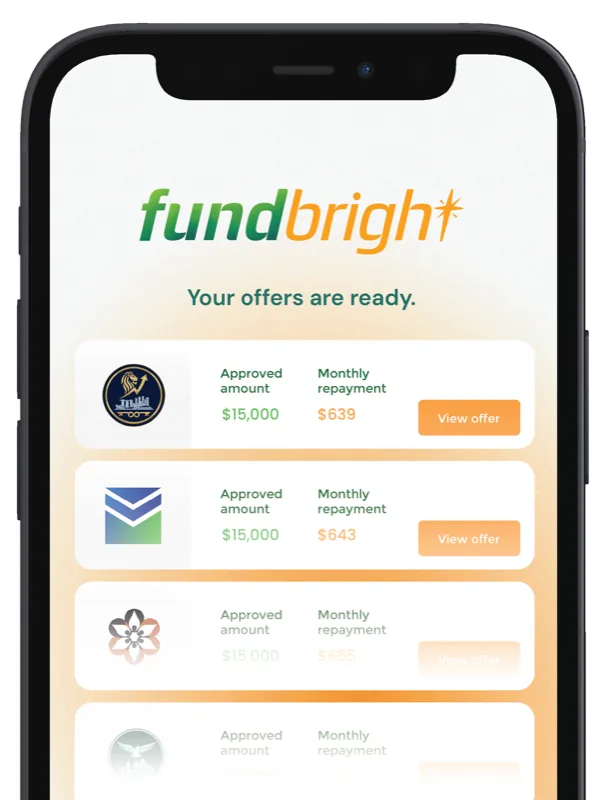
If a credit card rollover is costing you more than you realised, the first step is seeing what rate FundBright's network can return. One soft enquiry via Singpass. No hard pull. No documents. No fee from FundBright.
Best offer wins. No priority, no favourites. You stay in control.
Ready to find your best rate?
Get My OffersThese might also help

Ready when you are.Ready when you are.
checking will not affect your credit score