
Compare
FundBright vs MoneySmart and SingSaver: Multiple Offers, Not Multiple Applications
See how FundBright's commission model differs from MoneySmart and SingSaver's, and what it means for your rate. Compare now.
Some comparison platforms are paid a referral fee for each application a lender approves, and that fee is the same whatever rate the borrower ends up with. FundBright is paid according to the rate that is actually disbursed, verified after the fact. That single difference decides what each platform is built to optimise.
| Axis | FundBright | Affiliate-revenue model (as run by several incumbent comparison platforms) | What decides it |
|---|---|---|---|
| What triggers payment | Commission on a disbursed loan, falling as the rate the borrower is quoted falls | A referral fee per approved application, paid at the same level whatever rate the borrower is finally quoted | Whether payment depends on the loan actually disbursing |
| Panel composition | A network of licensed moneylenders operating under the Moneylenders Act, Cap. 188 | Varies by platform; composition is not independently verified for this comparison | Which lender types a borrower can actually be matched to |
| Outcome tracking | Closed-loop attribution captures the final disbursed terms after handover | Not disclosed in this comparison | Whether the platform can confirm what happened after the referral |
| What gets optimised | A 90% disbursement target | Approved-application volume, under an affiliate-revenue model generally | Whether the platform tracks the rate that disburses, or stops at approval |
The question that matters to a near-prime borrower is not which platform ranks higher on a search results page. It is which one is paid according to what actually happens to the loan, and FundBright's model is built around that outcome specifically.
The Affiliate Revenue Model in Plain English
Comparison platforms that run on an affiliate-revenue model are generally paid through referral or partnership arrangements with lenders, tied to whether an application is approved rather than to the rate the borrower finally pays. MoneySmart and SingSaver rank consistently in the search results for personal loan comparisons in Singapore, alongside several other established platforms, which places them among the market's active incumbents rather than fringe operators. That visibility says nothing about their internal economics. This comparison frames their revenue mechanism at the model-type level rather than asserting a specific figure or trigger for either platform individually, because the exact mechanic has not been independently re-verified against either company's current public disclosure. The distinction that carries weight for a borrower is structural, not reputational. A platform paid per approved application has been paid in full the moment the lender says yes, whatever rate the borrower was quoted. FundBright's commission moves with the disbursed rate itself, so the platform's own incentive stays attached to the outcome the borrower actually cares about.
How do sites like MoneySmart and SingSaver make money?
Comparison platforms in this category typically earn a referral or partnership payment from lenders, generally tied to an approved application rather than to the rate the borrower is finally offered. The specific commission structure for any individual platform is a matter for that platform's own disclosure, not a figure this comparison asserts.
Why Panel Composition Matters for Near-Prime Borrowers
A borrower who does not clear a bank's own approval thresholds needs a panel that includes licensed moneylenders, not a panel limited to banks. Panel composition, more than brand recognition, determines whether a comparison site can actually place a given borrower. This comparison does not assert that any named competitor's current panel is bank-only; panel composition varies by platform and by market, and the current mix has not been independently verified here. FundBright's own panel is built the other way round: every lender on it is licensed under the Moneylenders Act, Cap. 188, and operates within the Registrar's Directions issued by the Ministry of Law. A near-prime borrower, by definition, sits below the threshold that gets a standard bank product approved. The panel that can serve that borrower has to include lenders built for that segment.
Do loan comparison sites include licensed moneylenders, or only banks?
Panel composition differs by platform. A borrower who has already been declined or under-offered by a bank needs a comparison site whose panel specifically includes licensed moneylenders regulated under the Moneylenders Act, Cap. 188, rather than a panel drawn only from bank products.
One Application, or One Per Lender
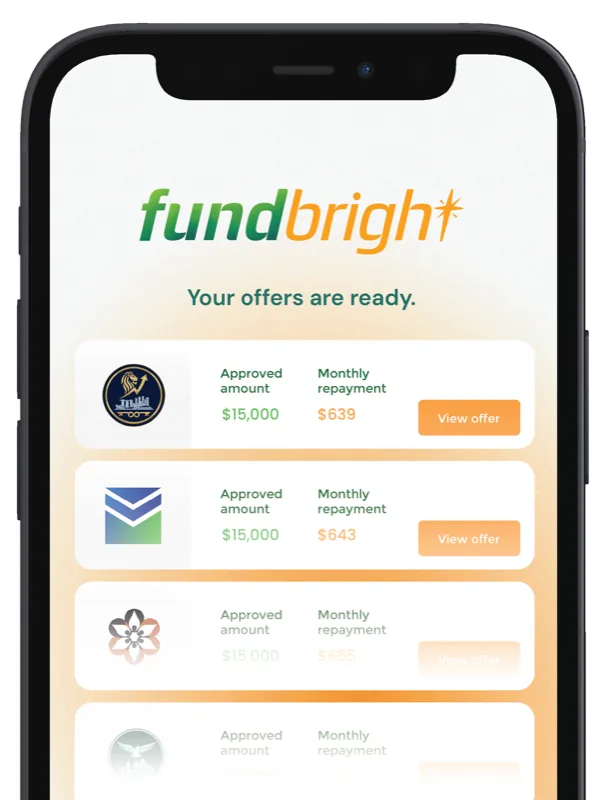
Comparing and applying are not the same step, and a broad-referral comparison site only does the first. The comparison happens on the site; the application does not. The borrower is handed off to the lender to apply, and being considered by several lenders means submitting several times, each with its own decision and its own record. FundBright works the other way round: one submission reaches the licensed moneylenders on its panel, and the offers come back for the borrower to compare, on a single soft enquiry, with the one mandatory hard check taking place in person only at the lender the borrower finally chooses.
Do I apply once, or once per lender?
On a broad-referral comparison site, comparing is one step and applying is another: you are sent to the lender to apply, and being considered by several lenders means applying several times. Through FundBright, one submission reaches the licensed moneylenders on the panel and the offers come back to you to compare.
What Tracking Disbursement Changes
A platform paid on approval is paid the same whatever rate the lender said yes at. A platform that tracks the disbursed outcome can align its own incentive to that result. A platform paid per approval resembles a recruiter paid the same fee whether the candidate is placed on a strong salary or a weak one: the placement is what earns the fee, not the terms. A platform paid against the rate that disburses has a reason to care which. That shift, from paying for an approval to paying against the disbursed rate, is what separates a flat performance fee from a commission that moves with what the borrower actually pays. Because the commission is calculated against the rate that actually disbursed, FundBright has to capture that rate: the closed loop is not a reporting nicety, it is how the fee is worked out. A fee earned at approval does not need that number. The same attribution captures the disbursed terms after handover, which is what makes the 90% disbursement target measurable rather than aspirational. A platform without that loop has no equivalent number to report.
Why does it matter if a comparison site tracks whether my loan is disbursed?
A platform whose fee is settled at approval has no commercial need to know whether its referral led to a workable rate. Tracking the disbursed outcome ties the platform's own commission to the borrower's actual result, not to traffic volume.
When Each Site Is Worth Using
A borrower confident of clearing a bank's own approval criteria is reasonably well served by a broad-referral comparison site built for volume. A near-prime borrower, carrying a thinner credit file or an income profile a bank has already declined, benefits from a platform whose own incentive is tied to the disbursed rate rather than the click. Knowing what a comparison platform is actually paid for facilitates a same-day comparison across FundBright's licensed-lender network, priced with the incentive to reach a disburseable, sub-ceiling rate. Best offer wins. No priority, no favourites. You stay in control.
Ready to find your best rate?
Compare Offers NowThese might also help
Ready when you are.Ready when you are.
checking will not affect your credit score